Showing posts with label pinot gris. Show all posts

Thursday, November 12, 2015

Hugel - The Wines of Alsace (Part Two)


Photo ©Hugel

There are so many days to celebrate, so why not a day for a winery? I never knew this until a few weeks ago, but November 14 is Famile Hugel day - Hugel, being the famed Alsatian producer, of course. 

Well, I'm game, so I tasted a few of their classic wines to get me in the mood. A few words about Hugel first; the firm was established in 1639 (!) and is today located in the charming village of Riquewihr in the Haut-Rhin section of Alsace (this is the southern half of Alsace and is considered the best wine area in the region). The winery is still family owned - how nice in this era of corporate buyouts and mergers - and is being managed by the 12th generation of the Hugel family.

There are several lines of wines produced by Hugel. Here are notes on three wines from the classic range:

2014 "Gentil"
"Gentil" is the name of a blended wine from this house; the wine is primarily Gewurztraminer, backed by smaller amounts of Pinot Gris, Riesling, Muscat and Sylvaner. There are pleasing aromas of Anjou pear along with hints of jasmine and peony. Medium-bodied, this is round with appealing fruitiness, good acidity and has a dry finish with a slightly bitter edge. I'd pair this with crayfish or quiche. The $15 price tag represents a good value.


2013 Riesling
Riesling is considered the jewel of Alsatian wine; for that reason alone, most examples will cost you at least $25, with most priced much higher. Here's one for $13, which is a rarity. It offers subtle notes of pear, elderflowers and a hint of petrol (a classic descriptor for Riesling). It's medium bodied and perhaps a bit shy on the finish, but for a dry Riesling at this price, one that will be even better in another year or two, it's a winner!


2012 Gewurztraminer
Here is the best wine of the four. Offering beautiful varietal aromas of lychee, yellow roses and grapefruit. Medium-full with very good weight on the palate. Very good acidity, impressive persistence, good complexity and excellent varietal character. Enjoy over the next 2-3 years, perhaps longer. Excellent!

If you think about it, November 14, being Famille Hugel day, is just in time for Thanksgiving. All of these wines would work well with your holiday meal, especially the Gewurztraminer with turkey. But if you prefer a more muted aromatic wine, opt for the Riesling or "Gentil" - they work beautifully with turkey, chicken, pork or many other dishes. Happy Holidays!

Monday, December 2, 2013

Amazlng Alsatians - My Dinner with Gustave


I absolutely love the wines of Alsace and believe that this is the finest collection of white wines in the world; taking into mind the whites from Burgundy as well as Friuli, Alto Adige and Campania in Italy, that's a strong statement, but one in which I'm convinced. Add to that the marvelous array of wines, from Pinot Gris to Riesling to Gewurztraminer as well as a few others (including one red, Pinot Noir) and you've got a collection of wines that can pair up beautifully with a wide range of foodstuffs.

Recently, I tasted through the wines of Gustave Lorentz, an excellent producer situated in Bergheim near the foothills of the Vosges Mountains. The family has been producing wine there since 1836 and today is managed by Georges Lorentz, sixth-generation vintner. They own a total of 85 acres of vineyards of which 34 are Grand Cru, with four at Kanzlerberg and thirty at Altenberg de Bergheim. In 2012, their vineyards were certified organic by Ecocert.

I've tasted a few entry level "reserve" wines from Lorentz over the years - quite often the Pinot Blanc- and have been very happy with the overall balance as well as the typicity of the products. They represent Alsace well and they're also fine values, with the Pinot Blanc coming in around $16 a bottle (sometimes even less).


I recently tasted through six of the current Gustave Lorentz wines at two dinners: one with Thai food - I find that Alsatian wines and Thai food are a match made in heaven - and then with the traditional Thanksgiving turkey and all the trimmings. The opening wine was the Cremant d'Alsace, which is a unique sparkling wine from Alsace. This is made according to the methode champenoise system; the wine is under less pressure than a traditional Champagne, hence the name cremant, translated as "creaming." The Lorentz version is a blend of 1/3 each Chardonnay, Pinot Blanc and Pinot Noir and is a delight. My tasting notes are as follows:

"Delicate yellow, fine perlage; aromas of golden apple peel and a hint of lemon custard. Medium-full with very good concentration. Nicely balanced, very good acidity and very good persistence. Well made, this is a very flavorful cremant that is quite dry; it is also one of the nicest I've had in some time. Enjoy over the next 2-3 years."

I enjoyed this with turkey and the Thai food; it worked well with both, as the acidity and cleanliness of this wine cut through the spice of these foods. The suggested retail is $25.


Lorentz also produces a very nice rosé, made entirely from Pinot Noir. This has a beautiful strawberry color with fresh watermelon and strawberry fruit, very good acidity and impressive depth of fruit. This is quite dry and nicely balanced. It also worked well with turkey (with gravy) and an array of Thai dishes. The suggested retail is $16.


Three other wines that are of excellent quality are the 2011 Gewurztraminer "Reserve", the 2007 Pinot Gris "Schofweg" and the 2008 Riesling "Burg". Gewurztraminer is a specialty in Alsace and it's always been a favorite of mine; this 2011 from Lorentz with its exotic lychee, pineapple and lemon tea aromas and dry finish is first-rate and a wonderful partner for all of the foods I've mentioned in this post. Enjoy this over the next 2-3 years; suggested retail of $25, which is quite fair.

The 2007 Pinot Gris from a single vineyard (an extension of Altenberg) offers inviting flavors and aromas of red apple and oragne peel backed by impressive depth of fruit and a lightly spicy finish; this was especially nice with Thai curry. This has the concentration to drink well for another 5-7 years; this is a delightful wine with a suggested retail of $30.

The 2008 Riesling "Burg," also from a single vineyard, is medium-full with lovely aromas of petrol and apricot (classic for this variety); the finish is long and very dry. 2008 was an excellent vintage in Alsace with expressive aromas and very good natural acidity; though not a year that produced the "biggest" wines, 2008 in Alsace yielded wines of beautiful varietal purity and structure. This is superb at present with pork and lighter game and white meats and should drink well for another 3-5 years, though I may be a bit conservative in that estimate. Riesling is certainly a hallmark of any Alsatian producer's portfolio and this is one that the Lorentz family should be proud of; suggested retail is $30.
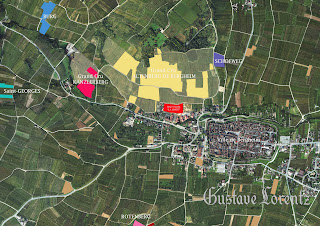


Finally, let's talk about the 2006 Gewurztraminer from the Altenberg de Bergheim Grand Cru vineyard (depicted in the above map). The Grand Cru appellation in Alsace was certified in 1975 with many of the first vineyards being designated as such in 1983; there are a total of 51 Grand Cru vineyards in Alsace. Altenberg de Bergheim, located a bit north of the town of Colmar in the Haut-Rhin ("Upper Rhine") section of Alsace is considered an exceptional site for Riesling and Gewurztraminer.

The Gustave Lorentz 2006 Gewurztraminer Grand Cru Altenberg de Bergheim is clearly a wine of great breeding, as you would expect. Light golden yellow with sumptuous aromas of lychee, apricot, mango and white roses - just this description alone makes me want to try this wine! - there is a richness and lushness, even an oiliness on the palate. Full-bodied with outstanding persistence and excellent acidity with ideal ripeness, this is a superb wine; my dining companion at the Thai restaurant (whose name was not Gustave) called this wine a "show stopper" and I heartily agreed. This is so delicious on its own, but it would be a shame to not pair this wine with food; this is perfect with Thai pork or chicken or even duck, while it would show off turkey and lighter game beautifully and would also be ideal with foie gras. This is such a unique wine for so many reasons; it has great complexity and power, yet it is always in balance, while the varietal purity is spectacular. This should drink well for another 7-10 years and the suggested retail price of $50 is quite fair, considering where this wine is from as well as its limited production.


Tasting through a lineup of wines such as these is a great exercise in discovering what the wines of Alsace are all about. Being able to experience such first-class offerings from Gustave Lorentz merely reinforced the marvelous quality of this renowned family producer.


The wines of Gustave Lorentz are imported by Quintessential Wines, Napa, CA.

Monday, September 9, 2013

Champagne - Seven grapes are better than three


Conventional wisdom about anything - automobiles, movies, sports - can be a tricky thing. Usually that information is true, or at least accepted as true. I won't get into the misinformation that clogs up the internet these days - I could write all day on that topic.

Take Champagne for example, when it comes to universal truths. We all know that an authentic Champagne - produced from grapes grown in the Champagne district of France - can be made from three grape types, namely, Chardonnay, Pinot Noir and Pinot Meunier. That's a fact that everyone knows - right?

Well it turns out that there are actually seven varieties permitted in the production of Champagne. It's just that you don't hear about the other four as only a handful of producers use these other varieties. Then consider that these four varieties account for approximately 1% of the total planting in Champagne and you can understand why these varieties are rarely discussed.

Still, they exist and here they are listed: Pinot Gris (also known as Fromenteau or Enfumé), Arbane, found only in the Aube district, Pinot Blanc (also known as Blanc Vrai) and Petit Meslier. They're all white varieties by the way, so that means there are a total of five white varieties that can be used in Champagne (Chardonnay, of course, being the other) with two red varieties: Pinot Noir and Pinot Meunier.

There actually are a few producers that craft a Champagne using all seven varieties and I recently tasted one, the Le Nombre d'Or "Campaniae Veters Vites" Brut from the great house of L. Aubry Fils of Jouy-les-Reims. This was the 2005 vintage and the primary grapes are Pinot Gris and Petit Meslier, while the other five varieties represent anywhere from 5% to 15% or 20% of the blend. The name incidentally means "the golden number," referring to all seven varieties in this wine. The specific cuvée name "Campaniae Veters Vites," means "old vines of the countryside." (Incidentally, there is also a Blanc de Blancs version of this wine - named Sable Blanc de Blancs - which is comprised of Chardonnay, Arbane and Petit Meslier.)

As you might imagine, this is a very distinctive Champagne; instead of the toasty, yeasty notes you find in the aromas of so many Champagnes, this has perfumes of green mint, dried pear, chamomile and even a hint of fig and dried yellow flowers. Medium-full, this is quite elegant and vibrant on the palate and there is a long, satisfying finish with very good acidity and a light earthiness. It's not an austere style of Champagne; it is delicious and extremely well balanced, and of course, displays marvelous complexity. It's beautiful now and should drink well for another 3-5 years - perhaps longer.


I may not have been in seventh heaven, but what a stylish Champagne!

Tuesday, January 24, 2012

Trimbach and Thai Food

Buy fine wine and check out our free shipping deals.


Back in November, I wrote a post about pairing Rosé Champagne with Thai food. I love Rosé Champagne and think it accompanies a wide array of foods, so I'd thought I'd see how well it partnered with Thai cuisine. The results were spectacular- great wines and wonderful food.

As that worked so well, I'm going to take a look at other wines from around the world and see how well they marry with Thai food. So I thought I'd do focus on the wines of Alsace this time around as these whites are recognized as arguably the ideal wines to accompany Thai cuisine. And what better way to do this than to sample this food with the wines of Trimbach?

One of the most renowned houses in Alsace, Trimbach was established in 1626 (yes, almost 500 years ago!) and is located in Ribeauvillé, where members of the 12th generation of the Trimbach family - namely brothers Pierre and Jean - manage the company on an everyday basis accompanied by their father Bernard and uncle Hubert. 


Like most wine houses in Alsace, Trimbach produces a wide variety of wines that represent the array of grape varieties in the region. Muscat and Pinot Blanc are produced, but the emphasis is on three varieties: Pinot Gris, Gewurztraminer and Riesling. Several examples of each of these are produced, ranging from a regular bottling to single vineyard offerings.

Along with two friends, I tasted out four Trimbach wines with the Thai food; three Reserve offerings - Pinot Gris, Gewurztraminer and Riesling - along with a special selection Riesling known as Cuvée Frédéric Emile. The Reserve line is really quite notable, especially given that these wines are retail priced at $25 each. The Pinot Gris (2006 vintage) is quite dry with a rich mid-palate and big finish - this is not like most Pinot Gris (or Pinot Grigio) produced elsewhere. The aromas are of dried pear, apple peel and yellow flowers and there is very good acidity. This wine showed very well and can be enjoyed for another 2-3 years.


I adore Gewurztraminer and this 2009 Reserve bottling did nothing to dampen my desire of this variety. The aromas are textbook - lychee and yellow roses - and thankfully, this is not as perfumed as some examples of Gewurztraminer. Medium-full with plenty of appealing spice in the finish, this has lively acidity and is quite forward and even a bit fat on the palate - this is so delicious right now! This wine just jumps out of the glass and welcomes you with its fragrances and spicy flavors and I can't quite figure out how they made a wine this good for only $25!

The 2009 Riesling Reserve is also an excellent wine, but this is a very different style than the Gewurztraminer. While the Gewurztraminer is quite forward, the Riesling is lean and subdued. It's got lively acidity and light touch of minerality (what we used to label as "steely" in a Riesling). There are beautiful aromas of lime, melon and white peach and the wine just sort of glides across your palate, while the finish is long and dry. This is fine now, but it will open up and reveal greater complexities with another 2-3 years and it should still be drinking well in another 5-7 years.


As for the Cuvée Frédéric Emile Riesling (this from the 2005 vintage), this is one of the most distinguished wines from the producer, a selection of grapes from several vineyards including the Grand Cru sites Geisberg and Osterberg. The grapes are picked later than normal, giving them maximum ripeness and flavor, without sacrificing much in the way of acidity and to preserve varietal purity, the wine is aged solely in steel tanks, as the Trimbach brothers believe that wood aging does not add anything to this wine. Medium-full with a rich mid-palate, this has a very long finish with lively acidity and a hint of ginger in the finish to go along with the notes of apricot and chamomile in the aromas. This is a big wine with excellent complexity, yet it is always balanced and never over the top. Showing beautifully now, it should drink well for another 7-10 years. The Cuvée Frédéric Emile is a very limited wine, which helps explain the $75 price.


As for the wine and food pairings, as I wrote above, the white wines of Alsace are classic partners with Thai food and this particular night confirmed that quite well. We ate at Siam Country, one of my favorite BYOB hangouts in Chicago and tried a variety of dishes from spring rolls to satay to ginger pork to chicken with noodles and green curry. Each of the wines worked very well with virtually every dish; particularly good pairings were the Gewurztraminer with the ginger pork, the Pinot Gris with the chicken with green curry and the Riesling with the spring rolls. If I had to choose one or two wines for an entire Thai meal, I'd go with the Riesling and the Gewurztraminer; the former for its richness as well as its subtleties in playing up to the food, while the Gewurztraminer accentuates the spice in the dish. I'm not sure I'd want to play up the heat of a curry dish, so in this instance, the Pinot Gris would be the ideal match, while the Frédéric Emile Riesling clearly could stand up to any of these dishes and was particularly good with any presentation of chicken or pork.

Of course, you don't have to have Thai or Oriental cuisine to enjoy with these Trimbach wines. Many preparations of pork, veal, chicken or vegetables or quiche work beautifully with these wines. That's one of the secrets of the great white wines of Alsace, especially when they are rendered by the Trimbach family!


The wines of Trimbach are imported nationally by Palm Bay.