Showing posts with label piemonte. Show all posts

Wednesday, September 8, 2010

Who Doesn't Love Raspberries?


I've been pleased with the reception to my recent post about Values from Piemonte. I'll have more to say about that in an upcoming post, but for now, notes on another fine value from this region.

This concerns a lovely sparkling wine called Rosa Regale produced by Banfi. Most consumers know Banfi for their wines from their gorgous estate in Montalcino in Tuscany, but they also produce wines from Piemonte, including Dolcetto and Gavi. The Rosa Regale is my favorite of their Piemontese wines and it's a bottling I look forward to trying each year.

This is a Brachetto d'Acqui, meaning it's made from the Brachetto grape, a specialty of the Acqui area near the town of Acqui Terme in the province of Asti. The Brachetto grape is all about fresh raspberries as well as strawberries and cranberries. The Rosa Regale from Banfi is made in a lightly sweet sparkling style, as is typical for this wine and it's delicious. I've loved every vintage of this wine I've tried for more than a decade now and the current 2009 is as flavorful and delicious as I've tasted. The $20 retail price is more than fair.

This is a wine that you don't need to take too seriously. It's a fun celebration wine and it's quite tasty - it's a real crowd pleaser. You don't age this wine - instead, drink it tonight or over the next 12 months by itself or with a simple pound cake or with fresh strawberries, as the locals do. This is also one of the few wines that is ideal with chocolate.

If you've never tried this wine, don't wait - you can thank me later!

Friday, June 18, 2010

Wine in Piemontese Ristoranti

Memo Melendez, Owner and Wine Director, Profumo diVino, Treiso
(Photo ©Tom Hyland)


Recently, Antonio Galloni, the Italian wine writer for The Wine Advocate penned a short piece on some of his recent experiences with the wine service at a few restaurants in Piemonte. (He also was highly critical of two restaurants in particular. Why someone who is not a food critic would do so seems a bit odd to me, but apparently not to him).

Anyway, his main point was that wine service in many of Piemonte's top restaurants was not what he thought it should be. He wrote that wine service in these restaurants was "appalling".

He certainly is entitled to his opinion and so am I. He focused on "top restaurants" in Piemonte and perhaps he is correct. As he undoubtedly makes a lot more money that the average wine writer (especially those of us who are freelancers), he certainly has the means to eat at more expensive restaurants that my colleagues or I do. So maybe he should dine at a few more modest trattorie and osterie in Piemonte, because I've never had a bad wine experience at any of these places. Not only are the wines well stored, they are served in very fine stemware. Most importantly, they are priced extremely well. Most wines purchased at some of the finest restaurants in the Barolo and Barbaresco zones cost the same price or even less than they would on a retail shelf in the United States. You can purchase 10 year-old Barolos for 50 and 60 Euro. How much would they cost in New York, Chicago or San Francisco (assuming you could even find them)?

So I'd like wine lovers out there to know that wine service at most restaurants in Piemonte is quite good, often excellent. If Galloni found some flaws, so be it and he has spoken his peace. But again he concentrated on more expensive restaurants and certainly for the money they charge, they should offer excellent service. It is a shame that he had some bad experiences, but believe me - as well as several of my colleagues from Italy and the United States - you will enjoy many excellent wines at very reasonable prices in the town of Alba and all throughout the Barolo and Barbaresco areas.

Alessio Cighetti, Owner and Wine Director, Vinoteca Centro Storico, Serralunga
(Photo ©Tom Hyland)


Here are just a few of the restaurants in these zones that have a first-rate wine program, combining an excellent list, fair pricing and beautiful stemware:


Profumo diVino, Treiso
Ristorante Le Torri, Castiglione Falletto
Trattoria La Libera, Alba
Antiné, Barbaresco
Bovio, La Morra
Antico Podere Tota Virginia, Serralunga d'Alba
Vinoteca Centro Storico, Serralunga d'Alba
Enoteca La Torre, Cherasco
EnoClub, Alba
Il Vigneto, Roddi

This is just a small sampling - there are dozens more. I certainly look forward to trying more new dining experiences in Piemonte - for both the food and the wine!

Tuesday, May 25, 2010

Great Champagne - in Piemonte!

Text and photos ©Tom Hyland


No matter which wine region in whatever country you visit, you'll find that winemakers need to try something besides their own wines from time to time. Sometimes, it's beer (especially on a hot day), at times it's another product from a local estate and then there are days when the choice is something totally different from what they produce.

In Italy, winemakers - as well as most wine drinkers there - adore sparkling wines. Look at how many sparkling wines are produced throughout the country; not just Franciacorta and Prosecco, but cuvées made from varieties such as Falanghina in Campania, Verdicchio in Marche and Ribolla Gialla in Friuli. It's quite a love affair Italians have with sparkling wine!

That extends, of course, to Champagne and it was with great anticipation that I joined my winemaker friends Sergio Germano (Ettore Germano) and David Rosso (Giovanni Rosso) from Serralunga d'Alba at a wonderful enoteca in that town called Vinoteca Centro Storico, home to one of the most varied selections of Champagne I've found anywhere outside of that famous zone. The owner, Alessio, is a charming young man who loves finding excellent Champagne from some of the finest artisan producers from Champagne and he's been rewarded for his efforts by the area's vignerons.

Alessio, one of Piemonte's greatest promoters of Champagne

I've met Sergio and Davide before at the enoteca and was anxious to see what we would be enjoying this particular evening. For starters, we enjoyed the Doyard Extra Brut, a very dry Champagne with only a slight dosage. The wine was an excellent start with a pronounced yeastiness and aromas of dried flowers. It was a great partner with the various salumi offered at the bar.


We then ordered a Georges Laval Brut Rosé, made in the saignée style, where the color is bled from the skins of the Pinot Noir grape. Bursting with ripe strawberry and cherry fruit, this was a delight! How nice that Alessio provides choices such as this, allowing the customer to experience a rainbow of flavors from Champagne in the heart of the Barolo zone!

A few days later, Sergio and I enjoyed a tremendous lunch at Antica Podere Tota Virginia, located in Serralunga with magnificent views of the entire Barolo zone. We enjoyed some amazing seafood (not the usual fare in Piemonte) from Chef Claudio Cagliero and with it, paired the non-vintage Larmandier-Bernier Blanc de Blancs Premier Cru (pictured at top of the page), a wine Sergio recommended for the quality/price relationship (the cost was a reasonable 45 Euro on the list). Quite rich with flavors of dried pear, the wine has a distinct minerality and excellent persistence with beautiful complexity. The wine made for a stunning pairing with our seafood (I had a plate of octopus, shrimp and swordfish that was incredible) and I'd order it again, especially at the price.

I admit that the prospect of trying more than 300 wines from the Nebbiolo grape that upcoming week made me long for sparkling wine (or just about any dry white). But these Champagnes were more than just alternative choices - they were excellent selections in their own right and reminders of how good the quality level is in the Champagne district.

Monday, November 30, 2009

Out of Touch - Again

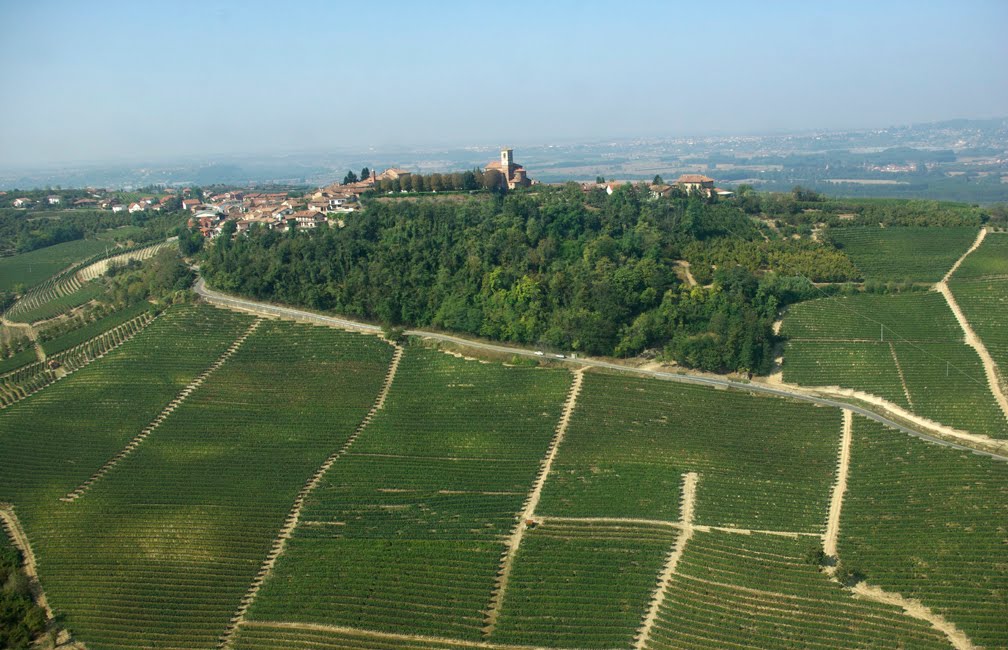
Serralunga d'Alba, one of Barolo's finest communes
Photo ©Tom Hyland


Wine appreciation is, at its most basic, an individual thing. What I think about one particular wine may not be in snyc with what you think. That’s fine – we can agree to disagree.

Yet along the way when wine lovers turn to someone for guidance, they want an accurate account of what certain wines have to offer. Again, you may disagree with one particular review, but for the big picture, you want the reality of the situation.

The December 15th issue of The Wine Spectator offers more evidence that James Suckling, who covers the Italian wine scene for the magazine, cannot be trusted to offer an accurate representation of that country’s wine industry.

This is nothing earth shattering, as Suckling has come up with some very strange accounts of Italian wines (more on that later), so this is just the latest in a string of faulty reports. But given the importance of this publication in many people’s eyes, it is worth reporting on.

This issue has Suckling’s take on the recently released bottlings of Barolo from the 2005 vintage. Basically, he has written that he slightly prefers this vintage to 2004. This may come as a shock to many who have had the experience of tasting a number of examples from each vintage. I am fortunate enough to taste more than 125 Barolos from every new vintage when the wines are presented for the worldwide press at the Alba Wines Exhibition, held in Alba each May, so I believe I am qualified to discuss this issue.

This year the 2005 Barolos were presented and overall, I thought the vintage was quite good, if a little uneven. As with every year, there are outstanding bottlings (Bartolo Mascarello, Francesco Rinaldi “Brunate”, e.g.), but there are not the sheer numbers of memorable wines as there were from 2004. That vintage was a classic, with excellent depth of fruit, beautifully defined structure and stunning aromatics. Many of the top bottlings of Barolo from 2004 can age for 20-25 years, in my opinion, while there are a few great bottlings that will peak at 35-40 years.

Comparing 2005, I think it is a very good vintage, as the wines have good depth of fruit and very good acidity. These are wines for the most part that will peak at 12-15 years after the vintage- a typical assessment on my part. Thus I’d give the 2005 vintage a rating of 3 stars (very good) while I awarded the 2004 vintage a rating of 5 stars or outstanding.

Others agree with me; one fellow journalist attending this event told me that the 2005 Barolos are nice wines to drink while you wait for the 2004s to come around. That’s pretty typical of what most journalists I spoke with thought of these wines – very nice, but hardly great and certainly not the equal of the 2004s.

Yet here comes Mr. Suckling professing his preference for the 2005s over the 2004s. Why? Basically he writes that the 2005s will offer more pleasure over the next decade. This is arguably true, as the wines are not as deeply concentrated, and thus are more approachable.

Yet, Suckling also writes that the 2004s will probably last longer than the 2005s when it comes to cellaring. Think about that! He admits that the 2004s will age longer, yet he prefers the 2005s. So what is he saying here? Basically he is saying that he likes more approachable wines when it comes to Barolo. Is this an accurate portrayal of what Barolo represents? Barolo is one of the world’s greatest reds, in large part, due to its aging potential as well as its ability to offer greater complexities and reveal more flavors as it ages. That’s a rare combination and one that should be prized.

For Suckling, Barolo can be a rich, powerful wine, but it can only be great if it is approachable at an early age. At least, that’s the best I can figure, given his ratings of recent Barolo vintages. His description of the 2000 vintage in Piemonte as a 100-point year (how ridiculous it is to rate a growing season on a 100-point scale?) is his most famous misrepresentation of Barolo. 2000 was a year that produced soft Barolos, ones with moderate acidity to go with the forward fruit. This easy-drinking vintage was in Suckling’s words, the “best ever” for Barolo, an absurd statement. Don’t take my word for it, ask any winemaker in Barolo about the 2000 vintage – you won’t find one who would even say that it was the best vintage in the last decade. So how can Suckling think that 2000 was the best vintage ever? (Further proof comes from tasting the wines – most are now at or nearly at peak and the fruit in many bottlings has dried out. Barolos peaking at 10-12 years of age? Hardly a description of greatness.)

You should realize that Suckling is an American living in Tuscany; it’s clear to me that he brings a California palate to Italian wines. He prefers a riper, more forward style of wine; thus a more traditionally made wine that has naturally high acidity with a subdued fruit profile is not something that he rewards with high scores. Winemakers in Piemonte call wines made in the fruit-forward style that Suckling prefers, “California Barolos”, referring for example to the wines from 1997 and 2000, two vintages Suckling lavished with high praise.

It’s easy to understand then that he is a fan of many Italian reds (especially Super Tuscans) that have little to do with the more classic approach of many Italian winemakers who respect the heritage and terroir of their land. (I could also argue that he favors wines of many of his friends in Tuscany, but I’ll save that for another day.)

Whether Suckling’s preference for forward, fruit-driven Italian wines is merely his preference or part of the requirement for any journalist at the Spectator is open to question, but let’s face it, his bias is all too obvious. Thus a classic vintage such as 2001 doesn’t get as high a rating as 2000, which is ridiculous- I don’t know how else to put it. And for 2005 to be rated as a better vintage than 2004 for Barolo, that’s more proof that long-lived Barolos aren’t what Suckling is looking for. That to me is not an honest portrayal of what Barolo is all about.

Vineyards at Verduno in the heart of the Barolo zone
Photo ©Tom Hyland


If this wasn’t bad enough, he also wrote a short piece on the 1999 Barolos and Barbarescos in this same issue. He writes that the 1999s were "never destined for greatness.” That did it for me! 1999 is an outstanding vintage as these wines offer excellent concentration as well as beautifully defined acidity, a combination winemakers – and wine drinkers – seek.

So why does Suckling believe that the 1999s are not great? According to his thinking, this wines are “lean.” Lean? The 1999s? He writes that they are not as concentrated as those from 1989, 1990, 1996 or 1997. He is arguably correct here, but does the fact that a vintage offers less depth of fruit that another mean it is not as good? What makes a Barolo or any wine great (and let me say here that the word great is overused by too many wine writers) is a combination of fruit, acidity, tannin and above all, balance. Bigger does not necessarily mean better. I have no problem with Suckling prefering the 1989, 1990 or 1996 vintage over 1999 (though I believe 1999 is far superior to 1997, as do many winemakers in Barolo), but to say that the 1999s from Barolo and Barbaresco aren’t great because they are not as intense as other vintages is futher proof of his misunderstanding of balance and structure as key roles in these wines. Callling the 1999s “lean” is like saying a 50-year old man who is 5’10” and weighs 175 pounds is lean. Compared to what, another 50-year old man of the same height who is 250 pounds? Maybe that man is overweight!

I’ve said it before and I’ll say it again – if you look to James Suckling for advice on Italian wines, you get what you deserve.

Tuesday, May 26, 2009

Cose che mi piacciono dell'Italia *

Pergola vines in the town of Furore, Amalfi Coast (Photo ©Tom Hyland)


* Things I Love about Italy
I just returned from a two-week trip to Italy - this time focusing on Piemonte and Campania. I’ll report on the new wines I tried in upcoming posts, but for now I’m writing a special entry, as this was my 40th trip to Italy.

This is all about my love affair with Italian wines, food and its citizens in general, so here is a brief list of what I love most about these topics.


The people
First and foremost, I have to mention the generosity and friendliness of the wine producers of Italy as well as the rest of its residents I’ve met over the past nine years. There are kind people everywhere, but Italians for me are the most gracious of all. They’re always asking if you have a nice place to stay or you’ve selected a good restaurant for lunch or dinner; if not, they’re glad to recommend somewhere. This is not just from producers I know, it’s been my experience with total strangers as well. Italians just have it in their DNA to be friendly; it’s a basic as that.

Its beauty
From the dramatic hillside vineyards in Alto Adige and Piemonte in the north to the extreme viticulture along the Amalfi Coast in the south, Italian viticulture is among the most specialized and remarkable in the world. A simple drive on the main road from Alba to Barolo is a dream come true for any wine lover or even just a lover of nature.

View of Cerequio and Sarmassa Vineyards from Barolo (Photo ©Tom Hyland)


The restaurants of Cuneo
Great food is a constant in Italy, but nowhere are the more excellent places to dine than in the province of Cuneo in Piemonte, especially in and around the town of Alba. This includes the Barolo and Barbaresco zones, so given the quality of these wines along with the local products, it’s no surprise. Among my favorite dishes that are classics in this area are agnolotti al plin (small ravioli stuffed with meat or a vegetable such as spinach) or coniglio al brasato (braised rabbit). There are too many restaurants to name; a few include Le Torri in Castiglione Falletto, Bovio in La Morra, Profumo di Vino in Treiso and Trattoria La Libera in Alba.

Trattoria La Libera, Alba (Photo ©Tom Hyland)


Gewurztraminer from Tramin
The town of Tramin in Alto Adige is the home of the Gewurztraminer grape. While there are other areas in this region that yield excellent examples of Gewurztraminer, the finest are from Tramin. There are three examples in particular: "Nussbaumer" from Cantina Tramin, "Kastelaz" from Elena Walch and "Kolbenhof" from J. Hofstatter. Each of these displays the gorgeous perfumes of grapefruit and lychee along with distinct spice and a lush, rich entry on the palate and are gorgeous food wines.


Campanian whites
The white wines of Campania are among the finest in all of Italy and are for me the best in terms of quality/price relationship. The most famous are Greco di Tufo and Fiano di Avellino from the province of Avellino; look for the excellent new 2008s just arriving on the market. (You may still be able to find examples from the outstanding 2007 vintage, which should be in fine shape.)

Falanghina is becoming a big success story in several zones in Campania; this is a flavorful white with pear, lemon and quince flavors and vibrant acidity. Finally, look for the rare whites from the Amalfi Coast, which are usually intensely flavored and high in acidity.

A few recommendations: 2008 Mastroberardino Greco di Tufo “Nova Serra” (one of the best examples ever of this wine), 2008 Greco di Tufo “Cutizzi” from Feudi di San Gregorio, 2008 Fiano di Avellino Terredora “Terre di Dora”, 2008 Falanghina from Vinosia, 2008 Tramonti Bianco from Giuseppe Apicella and the 2007 Fiorduva from Marisa Cuomo (these last two wines are from the Amalfi Coast). Look for most of these wines to be in the $20- $25 price range, with the Cuomo retailing for about $45).


Nebbiolo
Grown most notably in Piemonte, this is the grape that is the sole variety used in several great red wines of that region including the famous Barolo and Barbaresco as well as Roero Rosso and Nebbiolo d’Alba. Unlike some international red varieties that scream of ripe black fruit and display deep color, a well made Nebbiolo has a garnet color and aromas of red fruit (cherry, currant) and notes of tar, orange peel and nutmeg. The aromas and flavors of Nebbiolo, especially as expressed in Barolo and Barbaresco take you to another level. Wines made from Nebbiolo are especially wonderful with ligher game or poultry. Try a Barbaresco from producers as such Produttori del Barbaresco or Rizzi for a true representation of this wine, while producers such as Elio Grasso, Marcarini, Giovanni Rosso and Ceretto are among the dozens that craft outstanding bottlings of Barolo that offer beautiful sensations of terroir.

Gianluca Grasso, winemaker, Elio Grasso, Monforte d'Alba (Photo ©Tom Hyland)


Brunello di Montalcino
This is the most famous example of the Sangiovese grape from Tuscany. At once charming in its cherry and cedar flavors and yet powerful in its capabilities to age for 20-25 years, Brunello is a singular wine. The bottlings from the excellent 2004 vintage are just being released; among those to search out include those from Pian dell’Orino, Il Poggione, Col d’Orcia, Poggio Antico and Talenti.


Vin Santo, Recioto and other dessert wines
There are so many wonderful dessert wines produced throughout Italy; sadly, these wines rarely get the attention they deserve (a common problem worldwide). Vin Santo, the lush, caramel, apricot, honeyed specialty from Tuscany is most famous, but there are also outstanding examples of Recioto from the Veneto region, including the delightful Recioto di Soave from Garganega and Recioto della Valpolicella, with delicious black raspberry fruit and medium sweetness that pairs perfectly with aged cheeses.


Montepulciano d’Abruzzo
This is a fine introduction to modern Italian red wines, offering ripe black fruit, spice and notes of tar, clove and tobacco. These are enjoyable, delicious wines that don’t cost an arm and a leg (most are in the $14-$16 range, while a few of the single vineyard or selezione bottlings can run up to $35 a bottle). Given the recent earthquake in Abruzzo, let's show our support for the hard-working abruzzese by drinking a bottle of Montepulciano d'Abruzzo.

Worker in Abruzzo with just harvested Montepulciano grapes (Photo ©Tom Hyland)

Thursday, January 15, 2009

The Pleasure of Tradition - Piemontese Style


I enjoyed lunch at Francesca’s on the north side of Chicago with my friend and fellow Italian wine lover Jeremy McMahon the other day. Jeremy’s only been in the wine business for a few years, but he’s already accomplished something I haven’t – he’s worked a harvest in Piemonte. How I envy him for that!

We talked about his experience over lunch. He worked for Paolo Sarocco for the Moscato harvest in Castiglione Tinella and after finishing that, Sarocco told him about a fine Barbaresco producer by the name of Pasquale Pelissero (also known as Cascina Crosa), located in the town of Neive. Jeremy went to work there and by the way he told his story, I could tell that he loved his time in the vineyards (especially tasting the ripe grapes) and was grateful for the kindness of the local vintners.

He brought a bottle of the 2005 Barbaresco “Bricco San Giuliano” from Pasquale Pelissero and it accompanied our lunch like it was meant specifically for our spinach and pastas. This is a textbook example of this wine; my notes describe the currant and persimmon aromas, rich concentration, subdued oak, lively acidity and graceful finish.

We both loved the wine for numerous reasons, most specifically because it was an elegant accompaniment to our food. There was clearly no thought on the part of the winemaker to fashion a “big” wine that would be awarded high scores in a wine magazine. Rather the winemaking here was respectful of the fact that whoever tried this wine would enjoy it with food.

This is a classic concept in Piemonte and throughout most of Italy that is not always respected these days. Too many estates (usually in other regions farther south than Piemonte) are pushing the ripeness of their grapes and crafting modern, forward, overblown wines meant to impress certain influential wine publications. As my friend Jeremy Parzen wrote to me in a recent email, “these producers have sold their soul for a score.”

There’s been plenty written about this trend by Jeremy, Franco Ziliani, Alfonso Cevola and many other wine journalists who respect tradition and terroir in Italian wines. There’s no need for me to add that much more except to say that we need to keep reminding consumers that there are differences between wines that overwhelm you (the wow factor) and the ones that try to delight you. Tradition in Italian wines is all about the simple pleasure of pairing a wine with the local foods. How nice that the people associated with Pasquale Pelissero as well as hundreds of other Piemontese producers understand that!

Monday, December 15, 2008

Best Italian Importers - Part two


Sergio Germano, winemaker at Ettore Germano estate in Serralunga d'Alba, Piemonte. These wines are represented by Oliver McCrum (Photo ©Tom Hyland)


Best Italian Importers – Part Two

In my last post, I listed three importers of Italian wines that have put together an impressive porfolio of producers that honestly represent the spirit of that country’s wine landscape. Here is part two.

Oliver McCrum – Oliver McCrum Wines
Working in the wine business for thirty years, Oliver decided to focus solely on Italian wines a few years ago. Together with his assistant Michele Boscia at his office in Oakland, he has put together a book that is small, but well thought out. He represents about two-dozen producers from eleven different regions and is particularly strong with Trentino-Alto Adige, Campania and Piemonte.

His Piemonte selection is quite varied, with everything from brilliant Barolos from Elio Grasso and Ettore Germano to first-rate Barbaresco from Castello di Verduno to one of the finest producers of Moscato d’Asti, Caudrina. I’ve recently tried a few wines from his Campania producers and am quite impressed, especially with the Falanghina from La Sibilla, the Lacryma Christi del Vesuvio from Villa Dora and the Taurasi from Contrade di Taurasi.

It’s really nice to see someone so dedicated to representing such authentic, terroir-driven wines from Italy. Keep up the great work, Oliver!
omwines.com


Romigberg Vineyard of Alois Lageder, whose wines are imported into the United States by Brian Larky at Dalla Terra (Photo ©tom Hyland)


Brian Larky – Dalla Terra
Brian Larky has had a long time love affair with Italian wines and it shows in his portfolio. He worked at a winery in Italy in the late 1980s and soon afterwards founded Dalla Terra. He’s built his company into one of the most resepcted importers of Italian wines in this country, not only through his selection, but reasonable pricing as well.

His portfolio is a nice mix of tiny, underrated estates along with a few of Italy’s best-known producers, such as Badia a Coltibuono from Chianti Classico and Alois Lageder from Alto Adige. A few of his gems include Inama, one of the true artisan producers of Soave; La Valentina, an excellent estate in Abruzzo and Adami, one of the top producers of Prosecco, especially given the price/quality ratio.

Dalla Terra may be one of the biggest importers of premium Italian wine in the states, but the focus is always on quality and never on quantity, as you won’t find offerings of cheap Pinot Grigio or Primitivo with this book. Let’s hope that Brian Larky will add some new producers, but continue to represent estates that express the soul of Italian viticulture. dallaterra.com