Showing posts with label chilean sauvignon blanc. Show all posts

Wednesday, May 2, 2012

Birth of the Cool


Sauvignon Blanc grapes ready for harvest, Leyda Valley, Chile (Photo ©Tom Hyland)


If you've read my blog over the past two years, you know how much I love Sauvignon Blanc from Chile. For decades, red wines - especially Cabernet Sauvignon from Maipo Valley - have been the most acclaimed from this country, but little by little, more attention is being paid to the white wines, especially Chardonnay and Sauvignon Blanc from cool zones such as Casablanca, Leyda and San Antonio Valleys, located not far from the Pacific Ocean.

I'll deal with a number of these wines in two posts; today's will deal with three Sauvignon Blancs from 2011:


Viña Los Vascos Sauvignon Blanc 2011 (Casablanca Valley)
At the outset, I must admit I have been routinely disappointed with the wines - white and red - from this Chilean firm, owned by the Lafite-Rothschild company of Bordeaux. So I was thrilled to enjoy this lovely Sauvignon Blanc which is quite simply, delicious! There are beautiful lime, pear and peach fruit flavors and excellent persistence, but it's the sleek, vibrant acidity of this wine that holds everything together and begs you to try another sip. This is clean - no oak aging- and very refreshing. Enjoy this over the next 2-3 years with shellfish, whether sautéed or even lightly grilled- it's lovely with either. Suggested retail price - $14. Considering the price of a similar quality Sauvignon Blanc from France or California, this is an excellent value.


Casa Silva Sauvignon Blanc "Cool Coast" 2011 (Colchagua Valley)
When I tasted the 2009 version of this wine (I believe that was the inaugural release), I was blown away! (read here). The 2011 version is on par with that wine, as this is all about exotic aromatics of pink grapefruit, mango and pineapple, backed by a rich mid-palate and vibrant acidity. Colchagua is not thought of as a valley in which to produce top-notch white wines in Chile, but the owners of Casa Silva have found a small parcel near the ocean that delivers outstanding fruit. Enjoy over the next 2-3 years with shellfish and especially with Thai food. Suggested retail price - $25.


Cono Sur Sauvignon Blanc "Vision" 2011 (Casablanca Valley)
Here is one of the best wines from Chile as regards to outstanding quality and an excellent price. This is a single vineyard Sauvignon Blanc from Casablanca Valley that is simply irresistible! This has complex, gorgeous aromas that just scream Sauvignon Blanc with notes of gooseberry, spiced pear, melon and freshly cut hay. These perfumes just jump out of the glass- one smell of this wine and you're hooked! Superb texture and excellent persistence - you'd think this had seen at least a few months or oak aging, but there was no oak contact at all with this wine, only steel. Vibrant acidity and a flavorful finish with appealing notes of spearmint and tarragon. This is great now and should be consumed over the next 2-3 years, not only with shellfish, but also rich seafood such as Dover sole and halibut- don't worry, this wine will stand up to almost any seafood. Outstanding value at $15 and an outstanding wine, period!


I'll review more cool climate whites from Chile - Sauvignon Blanc and Chardonnay - in an upcoming post - but for now, the moral of the story is that 2011 was a great vintage for Sauvignon Blanc throughout Chile. Don't miss out on these great values!


Tuesday, December 20, 2011

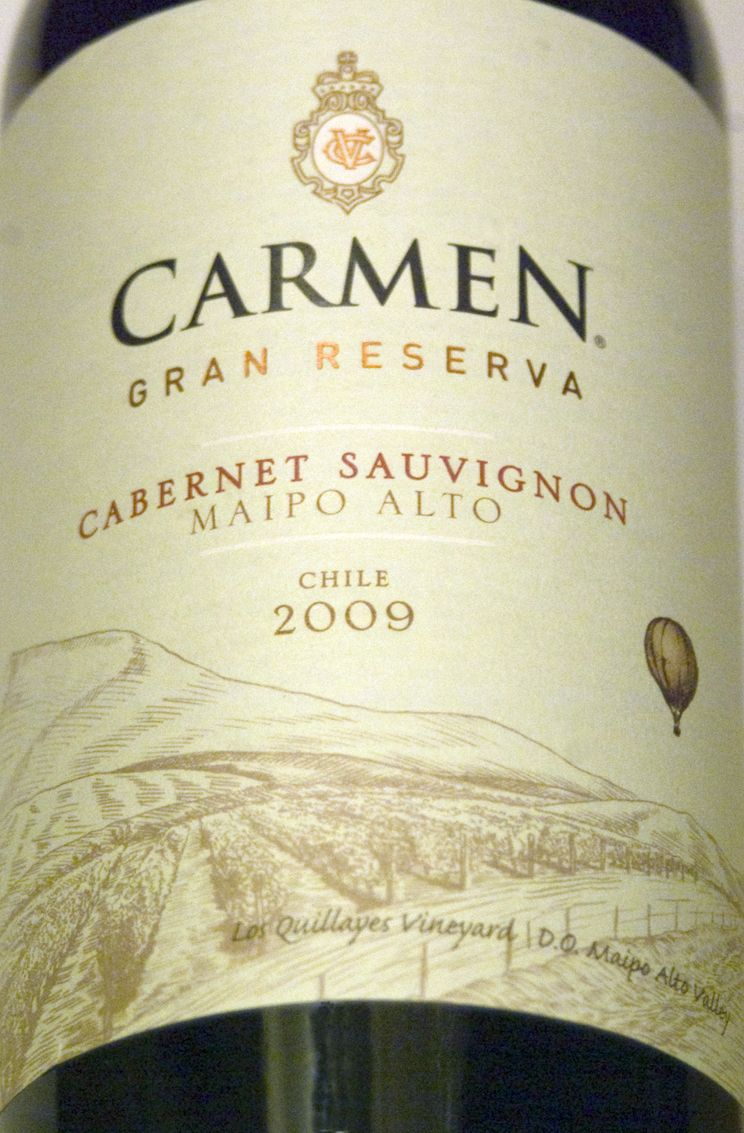
A Solid One-Two Punch from Carmen


I've thoroughly enjoyed the wines of Carmen, Chile's oldest wine producing company, since I was first introduced to them a little more than a decade ago. From the medium-priced riserva line of wines to the premium Gold Label offerings, this winery has always delivered the goods.

I've recently tried the new releases from Carmen, which have seen a new label design for the Gran Riserva wines as well as a new national importer, Trinchero Wine Estates from California. There are six wines in the Gran Riserva line, which represent Carmen's dedication to the various terriors of Chile. Thus the Chardonnay is made from grapes sourced from Casablanca Valley, while the Sauvignon Blanc is from the cool Leyda Valley, only a few miles from the Pacific Ocean.

The Carmenere comes from estate vineyards in Colchagua Valley, a few hours south of Santiago, while the other reds (Cabernet Sauvignon, Merlot and Petite Sirah) are all sourced from Carmen's beautiful hillside estate in the Alto Maipo, about a 45-minute drive southeast of Santiago.

My two favorite wines in the Gran Riserva lineup are the Cabernet Sauvignon and the Merlot, both from the 2009 vintage. Of course, the Alto Maipo is famous for Cabernet Sauvignon, as the wines here have good richness, lovely varietal character as well as soft tannins, which gives them an immediate drinkability. This Cabernet Sauvignon has good persistence and balance and along with the textbook varietal flavors of blackcurrant and red cherry, there are also notes of tobacco and dark chocolate.

The Merlot is the real surprise, however. Merlot gets a lot of bad publicity these days for various reasons, but if more were made like this, you'd read a lot more positive notices for the grape variety. Black cherry and black plum fruit dominate this wine and the tannins are polished as you might expect. This is very drinkable now and will be a fine partner for most red meats - especially lamb - for the next 2-3 years. Both of these wines are $15 retail (all the Gran Riserva wines sell at the same price) and these two reds in particular are excellent values.


Carmen has also released the 2007 vintage of their top red, the Gold Label Cabernet Sauvignon. I've been enjoying releases of this wine for the past six or seven vintages and have rated this wine as either excellent or outstanding every year. The wine is made from a beautifully sited vineyard that was planted in 1957; thus this 2007 release is from 50-year old fruit! Yields are low, the fruit is deeply concentrated on the palate and there is excellent persistence. As you might imagine, a wine this rich and young needs a bit of time in the bottle; I enjoyed this for dinner the other night at Al Dente restaurant in Chicago with a pork chop with poblano and red peppers, portobello mushroom and chipotle tomato coulis and as you might imagine, it was a heavenly pairing! The wine definitely needs at least 60-90 minutes of breathing time for enjoyment for dinner tonight; however the wine is just an infant and will improve for another 10-12 years, when it will be at its best.

The price on this gorgeous Maipo Valley Cabernet Sauvignon from Carmen is $50. I can guarantee you that a Cabernet Sauvignon made from 50-year old vineyards in Napa Valley would cost you at least $75 and probably more like $100 or $125 a bottle. This is another excellent value.

Here's to the consistency of Carmen wines, be it at $15 or $50 a bottle. This remains one of Chile's finest producers, I'm quite pleased to say!

Monday, October 31, 2011

Terroir-Driven Whites


The principle of terroir is a difficult one to precisely explain, but the main principle in explaining terroir is that wines differ according to where the grapes were grown. Thus two wines made from the same variety (or varieties) grown in sites only a few hundred yards apart, can taste entirely different.

Generally, any discussion of terroir tends to focus on red wines, often some of the world's most famous. These inevitably include the offerings from Burgundy's Cote d'Or (the holy grail of terroir), the Barolo zone in Piemonte or Napa Valley with its Cabernet Sauvignons.

Yet many white wines are also the result of terroir; certainly one can taste the differences in the great Rieslings of the Mosel or Rhine valleys in Germany or with the brilliant whites coming from Montrachet, Meursault or other communes in Burgundy as well as the amazing whites wines of Alsace.

I'd like to add two wine types to the discussion of terroir. These are Sauvignon Blanc from San Antonio Valley in Chile and Riesling from Clare Valley in Australia. I enjoyed beautifully made examples of each wine recently and it struck me that these offerings have as much to do with terroir as any of the great reds of the world. Whites rarely get the same lofty treatment many reds wines receive, which is understandable, but at the same time unfair. So I'm doing my part in taking steps to correct this situation.

The San Antonio Valley, a sub-region of the Aconcagua Valley, is located in close proximity to the Pacific Ocean; most plantings are within 8-10 miles of the ocean, while a few are as close as two miles away. This is most definitely a maritime climate as sea breezes help moderate temperatures. It can be very cool during certain growing seasons, meaning this is a also a razor's edge climate, giving a sharp focus to this wine with naturally high acidity.

Several varieties have flourished here including Chardonnay, Riesling and Pinot Noir, but to date it is Sauvignon Blanc that San Antonio Valley has become best known for. The wines offer intense aromas, but not as much gooseberry as in the bottlings from Marlborough Valley in New Zealand, nor are these wines as mineral driven as the finest Sancerre from France's Loire Valley.

Thus Sauvignon Blanc from San Antonio Valley (Leyda Valley, a sector of San Antonio, has also become an outpost for this variety) has its own signature. Aromas of pink grapefruit, melon and freshly cut hay are often present. Here are my notes on the 2010 EQ Sauvignon Blanc from Matetic. (D.O. San Antonio):

Aromas of green melon, hyacinth, Bosc pear and snow peas; medium-full with a rich entry on the palate. Good length in the finish with very tangy acidity; a sleek, delicious wine that is nicely balanced with very good complexity and balance. 


This would be ideal with most shellfish; I especially love it with sautéed shrimp; the cost is $20 US retail. Other excellent Sauvignon Blanc from San Antonio (and Leyda) include two single vineyard bottlings from Casa Marin (Cipreses and Laurel Vineyards) along with Amayna, who produces both a barrel fermented and tank fermented example of Sauvignon Blanc. These two producers tend to bring out more raciness in their wines, which are often better suited with richer seafood or even certain types of poultry. (The importer of the EQ wine is Quintessential.)


Another great example of terroir in white wines emerges from the Clare Valley, located a bit north of the Barossa Valley in the state of South Australia. While Barossa is known for its excellent Shiraz, it is Riesling that has become the signature variety of the Clare Valley. Unlike San Antonio Valley in Chile, Clare Valley is far from the ocean; this has a moderate continental climate with cool to cold nights, warm to hot summer days and low humidity.

The Rieslings from here are quite dry with distinct minerality and often feature notes of petrol in the nose, which make them very different from the apple, pear and apricot aromas of Rieslings from the Mosel and Rhine Valleys in Germany. The sub-district of Watervale in the Clare Valley is an ideal zone for growing Riesling; this is where the grapes for the Kilakanoon wine is from; the particular spot is called Mort's Block and the vines here have an average age of 40 years.  Here are my notes in the 2010 bottling:

Beautiful aromas of petrol, lemon peel, quince and turmeric; medium-full with very good concentration. Very good acidity and a dry finish with very good persistence. Lovely touch of minerality and stoniness in the finish, which adds to the complexity. Clean as a whistle and so delicious!


The US retail price is $20. I'd expect this wine to drink well over the next 2-3 years, but I may be a bit conservative in that estimate. There's probably no reason this wouldn't be in fine shape in another 5 or 7 years. Still, it's so tasty now that I don't know why you'd wait. This is wonderful with Oriental or Asian cuisine or seared scallops. (The importer is Old Bridge Cellars.)

Monday, September 26, 2011

Singular Wines from Anakena

Impressive new releases from Chile that I've tasted recently include two wines from the Single Vineyard line from Anakena Winery. Located in the Rapel Valley, the winery has vineyards in several areas of the country, including Cachapoal, Leyda and Colchagua Valleys.

There are several lines of Anakena wines from the basic Varietal wines to the premium Ona wines, small lot bottlings that include Pinot Noir, Syrah and blends including Riesling/Viognier/Chardonnay and Cabernet Sauvignon/Carmenere/Syrah.

Here are notes on two bottlings from the Single Vineyard series- both are suggested retail price of $14 on US retail shelves:

2010 Anakena Sauvignon Blanc Single Vineyard "Yunco Plot" (Casablanca Valley)
Located west of Santiago, Casablanca Valley is a cool climate zone not far from the Pacific Ocean; first planted in the 1980s, it is an ideal spot for varieties such as Pinot Noir, Chardonnay, Riesling and Sauvignon Blanc. Pleasing varietal aromas of spearmint, gooseberry and freshly cut hay. Medium-bodied, this has an elegant entry on the palate along with good acidity and subtle herbal notes in the finish. This is a nicely made cool-climate Sauvignon Blanc. Enjoy over the next year with shellfish or lighter chicken dishes.

2010 Anakena Carmenere Single Vineyard "Malva Plot" (D.O. Peumo)
The Peumo appellation is located in the western reaches of the Cachapoal Valley in western central Chile. Bright purple with inviting aromas of black raspberry, mocha, nutmeg and vanilla. Medium-bodied with very good concentration. Fresh and quite tasty, this is a delicious wine with well-defined varietal character, good acidity, round tannins and a distinct spiciness in the finish with notes of black pepper and cumin. Very appealing now and over the next 1-2 years. Very good value.

A few additional words on this wine. If you like Malbec from Argentina, with its spicy, peppery qualities, you'll love this wine. At $14, this delivers a lot of character and pleasure and is better than most examples of Malbec at this price. If I was purchasing wine for a steak house, I'd buy multiple cases of this wine, pour it by the glass and then watch the patrons enjoy themselves, especially as they order a second glass. It's that good! (This would also make for a wonderful everyday red for many consumers - pair it with barbecued ribs, pork chops, steaks or roasts.)


Thursday, September 1, 2011

Value and Character - the Chilean Way


After a hot July and August, I've returned to trying wines again. A number of reasonably priced Chilean wines have come across my desk lately and I've been especially impressed with two - one white and one red.

The white is the 2010 William Cole Sauvignon Blanc "Columbine Special Reserve" from Casablanca Valley. This wine region has become one of the leading in Chile for production of cool climate varieties, especially Pinot Noir and Chardonnay. But other varieties, such as Syrah, Riesling and Sauvignon Blanc are also playing an important role here as well.

I've always liked William Cole's wines and have especially loved his price points, which are generally in the mid-teens. I can't say that I've always been wild about the wines, as some of them are pleasant, if a bit straightforward. But with this Sauvignon Blanc, Cole has really delivered a lot of character for not a lot of money. The wine has beautiful varietal aromas of freshly cut hay, so you immediately know it's a Sauvignon Blanc that plays it straight ahead; this is not a Sauvignon Blanc pretending to be a Chardonnay.

Medium-full and aged only in stainless steel, so as to highlight the grape's fruit character, the wine has tangy acidity and notes of fresh lime in the finish. I've enjoyed it with everything from pork fried rice to sautéed shrimp and think how perfect this would be with a fish preparation with lime sauce, such as ceviché! Best yet, the US retail price is $15 and believe me, there's an awful lot of character for the money. This is a cool climate Sauvignon Blanc that many producers in Chile make so well- the acidity keeps the wine fresh and overall the wine has a delicate feel on the palate, while still displaying nice texture. Well done, Mr. Cole!


The second wine is the 2010 Meli Carignan from Maule Valley. Maule is located further south in Chile and there are plenty of old vines here planted to Cabernet Sauvignon, Merlot and Carmenere, although white varieties such as Chardonnay and Sauvignon Blanc are also an integral part of this landscape.

Meli produces a Carignan, a grape most commonly associated with Southern France. What's distinctive about this wine are not only the moderate tannins (especially compared to Cabernet Sauvignon), but also its currant and red plum flavors - this is not a big, super ripe jammy red that is too often produced around the world these days. Rather, this is a subdued red, medium full with a light peppery note in the finish and good acidity, meaning the wine has a freshness and edge that makes it a wonderful food wine. Pepper steak would be a perfect match, as would lighter game birds or even something as simple as a chicken or pork taco or empanada. The price on this wine is also $15.

Both wines are imported by Global Vineyard Wine Importers of Berkeley, CA

Wednesday, December 16, 2009

Another Great Sauvignon Blanc from Chile


I have a love affair with Sauvignon Blanc from Chile, so when I hear about a new release that looks intriguing, I have to try it. So when Margaret Snook profiled the Casa Silva Cool Coast Sauvignon Blanc in her blog recently, I was determined to find this wine.

Fortunately for me, the importer of this wine – Vin diVino – is about a five minute’s walk from my home, so I was able to get a sample bottle, as the wine had just arrived a day or two earlier. I tried the wine this week and can tell you it is worth the early raves.

Casa Silva recently released this 2009 Sauvignon Blanc from their new Paredones Estate (planted in 2006) located just five miles from the Pacific Ocean. Vintners in several areas in Chile have been looking to cool climates for Sauvignon Blanc as well as Chardonnay, Syrah and Pinot Noir to a greater degree over the past decade and the results have often been spectacular, as with the bottlings from San Antonio and Leyda Valleys, a bit west and south of Santiago. This estate of Casa Silva is an exciting new venture, at it is located in the Colchagua Valley, approximately one hundred miles south of Santiago. As Colchagua is best known for its powerful red wines, it is fascinating to see Casa Silva turn to Sauvignon Blanc in this region (this new estate is also planted to Pinot Noir, a variety that must have a cool climate to thrive.)

The wine is truly special – here are my tasting notes:

Brilliant straw with a slight youthful effervesence. Room-filling aromas of grapefruit, lime and pear zest. Medium-full with excellent concentration. Richly textured with great persistence of fruit, vibrant, lip-smacking acidity and outstanding texture. Superb varietal character. So appealing now, but should drink well for 3-5 years.

Simply put, this is an outstanding Sauvignon Blanc that is among the three or four best I have ever tried from Chile. How exciting that another new zone in Chile has emerged for extraordinary cool climate Sauvignon Blanc. This has been one of the major developments in the wine industry over the past five or six years and if you haven’t tried a Sauvignon Blanc from a producer such as Casa Marin, Leyda, Matetic (EQ) Amayna or now Casa Silva with their Cool Coast bottling, you need to find these wines and discover what all the excitement is about!

The 2009 Casa Silva Cool Coast Sauvignon Blanc will be available on a limited basis in a few US markets. Suggested retail will be a very reasonable $22 per bottle.