Thursday, January 12, 2012

A Unique White from Puglia


Although I've said it before, it bears repeating that while the Italian wine industry is unique, the main reason is that growers all over the country work with indigenous varieties. In a world where more and more products - be it wine, food, or whatever - start to become similar, it is wines made from varieties such as Dolcetto, Lagrein, Friulano, Greco, Fiano and hundreds, perhaps thousands of others that stand out as products that reflects the true legacy of the land. These are wines that reflect the soul of the farmers that work with these varieties.

While I've tasted thousands of wines made from indigenous varieties over the course of my 50 trips to Italy, I'm always finding new ones. Recently, I tasted a white wine from Puglia that I had never sampled. The wine is from Masseria Li Veli and it is made entirely from the Verdeca variety.

Masseria Li Veli is located in Salice Salentino in southern Puglia and has begun a special project called "Askos" for limited production wines made from varieties that are threatened with extinction; Askos is a wine jar and is the symbol for this project. The first red is from the Susumaniello variety and now we have a white, Verdeca.

This initial release is the 2010 and the wine is a blend of 90% Verdeca and 10% Fiano Minutolo; the designation is IGT Valle d'Itria. Deep yellow in appearance, due to skin contact, the wine has aromas and flavors of tangerine - this is quite dominant in the nose and very attractive - as well as dried pear and yellow flowers. Medium-full, the wine, aged solely in steel tanks, has a rich mid-palate and a long and flavorful finish with very good acidity. Displaying excellent complexity, this is a delicious white with lovely balance and style. I'd pair this with a variety of foods, from sea bass to roast pork or chicken. It is tasting out great now and will offer a great deal of pleasure for the next 2-3 years. For $18, this is a remarkable wine and an excellent value.

Lest you think that wines such as this are meant only for those looking for something very unusual, this is a real-crowd pleaser and I'm sure that people who like Chardonnay with little or no oak would love this wine. Bravo to Masseria Li Veli for producing this wine and to Dalla Terra for importing this wine into the United States!

Tuesday, January 10, 2012

The Importance of the Printed Word


After a bit of a holiday break to refresh the batteries, it's time to get back to posting on this site. For this first post of the year, I'm taking a break from my standard wine recommendations and am publishing an essay. I'm on my soapbox here, so I hope all of you readers don't mind, but I think this is important. I'll be back to my regular wine choices the next time out.

I'm certain most of you already know this, but wine magazines are being replaced by other avenues, from blogs to iPads. There are several reasons for this, most importantly the economic crisis of the past few years. This is true in many industries, so this isn't just affecting the wine publications, as auto, fashion, sports and movie magazines are either going out of business or publishing smaller issues. There isn't the advertising money out there like there was just five years ago, so there are problems.

Of course, one big reason for the demise of some wine publications is the increase in wine blogs. As someone who makes a living writing about wine (I've written for wine publications for 13 years now), I accept that fact, which is quite clear, as I also publish a wine blog. It's good exercise for me and it's a nice avenue for me to write about certain wines I couldn't write about in a print article.

People today are also turning to apps on smart phones to learn about wine. Technology has changed many industries and it's no different with wine. I actually welcome new ways in which to learn, because, let's face it, there is no one way to take in new knowledge. It's how much you can learn, however, from an application versus an article in a magazine, that makes the difference.


What all of this is leading me to is this. I recently read an article from The World of Fine Wine, a first-rate wine publication from England (full disclosure - I write for the magazine), that made me think about wine in a new light. The article is by Terry Thiese, one of the best-known importers of wines from Europe; the wines he represents have received tremendous critical praise. In this article, which you can read here, Thiese talks about several factors in wines that may or may not equate to quality; these include issues such as concentration, balance and deliciousness (I love that word!). Thiese talks about what these terms mean to an individual wine drinker, so this is an article about how each person's set of values affects his or her appreciation of wine.

Thiese also talks about yields in wine and how we have been led to believe that the best wines are made from the smallest yields. Many in the wine business accept this as almost a universal truth, but Thiese warns against taking this literally. He makes a solid argument about this and several other issues and it's insight such as this from the author that makes this such a valuable article. I think it's something every wine drinker should read.

I point this out because Thiese flies in the face of accepted wisdom on yields. People who believe that the best wines are always made from the smallest yields also tend to believe that the wines that receive a 95 or 96-point rating from an influential wine magazine are "better" than similar wines that garner 87 or 88 points. It's the "bigger is better" argument. As one winemaker told me once, "Bigger isn't better, it's different." Amen to that! It's like saying the best player on a basketball team is the tallest player - maybe he is, but then again, maybe he isn't.

This is another argument against rating wines with points. I've written about this before and I'll do it again, but for now, my point is this. By not reading wine magazines - indeed, how long before there are no wine magazines?- but instead using technology such as applications on smart phones, you learn about wine via soundbites. It's the quick and easy way to learn about wine- these apps will tell you that a certain vintage was better than another or that one part of a wine region is better than another, yet how can one judge individual style or preference this way? Wine is a sensory experience, so what you sense in a glass of wine is probably going to be different than what I encounter.


It's neat that there are new ways to learn, but preferring those over the traditional print publications can have its drawbacks. How does one learn about the appassimento method used to produce Amarone, one of Italy's most powerful reds, on a smart phone? How can you get a feeling for the difference between a Champagne from a large house as contrasted with that of a small grower while using a phone application? You learn about these subjects and hundreds more in the wine world over time, by reading articles and tasting wines. Points don't tell you about the style of wine and a phone app doesn't give you much insight. You have to put in the time to understand these things - there are no shortcuts.

So use your smart phones if you will or look on the internet for some reviews, but if you want to truly understand wine, take the time to read a wine article in a reputable wine publication that was written by someone who knows a good amount of the subject and then edited by another person who also knows about the value of good writing. In the final analysis, there is no substitute for that, with one important exception, tasting the wines themselves and making your own judgment.


Text and photo ©Tom Hyland

Wednesday, December 21, 2011

A Lovely Holiday Present from Mumm


Most Champagne houses, no matter how large or small, produce several different examples of Champagne. From the basic non-vintage (or multi-vintage, if you will) to the ultra premium tete-de-cuvée, producers make a Champagne for various tastes at various price points. I'd like to tell you about a particular bottling from G.H. Mumm, one of the largest and most famous of all Champagne houses.

While Mumm produces a typical house style non-vintage Brut as well as a premium cuvée called René Lalou, they also craft a lovely wine called Mumm de Cramant that is somewhat of an unknown gem. The wine is a Blanc de Blancs, meaning it is 100% Chardonnay; in this instance, all of the grapes are from vineyards owned by Mumm in the village of Cramant. This is a famous village in the Cote des Blancs section of the Champagne area; the vineyards Mumm uses are rated as Grand Cru, the highest-rated plantings in Champagne, so the quality of these grapes is exceptionally high.

The wine is also known as a Cremant - "creaming" - meaning this wine has less pressure than a traditional Brut. Mumm refers to this style of Champagne as a "demi-mousse"; indeed the wine has only 4.5 bars of pressure as compared to 6 bars with most Brut, resulting in a softer, rounder finish. The wine was once known as Cremant de Cramant, but it is now known as Mumm de Cramant, certainly an easier name to remember and one that includes the producer's name.


I've enjoyed this wine on previous occasions, but this was the first time in several years I had tasted this and I was very impressed. My notes focus on aromas of lemon peel, Bosc pear, graham cracker and yellow flowers. Medium-full, with impressive structure, the finish is quite long and features a distinct note of minerality. Above all, I love the complexity of this wine, as well as its delicious fruit and stylish nature. I've liked this wine before, but for me, this particular bottling was the finest I've tasted to date. I would pair this with a number of foods, from shellfish (shrimp or oysters would be ideal) to Asian cuisine to lighter poultry. The price for this limited Grand Cru Champagne is $75, which I think is quite fair.

One other note - the top right hand corner of the label is folded. This symbolizes a French tradition of a special gift which would be delivered in person along with a card or envelope that had its top corner folded down. What a nice tradition, especially at the holidays and what a lovely wine from Mumm!

Tuesday, December 20, 2011

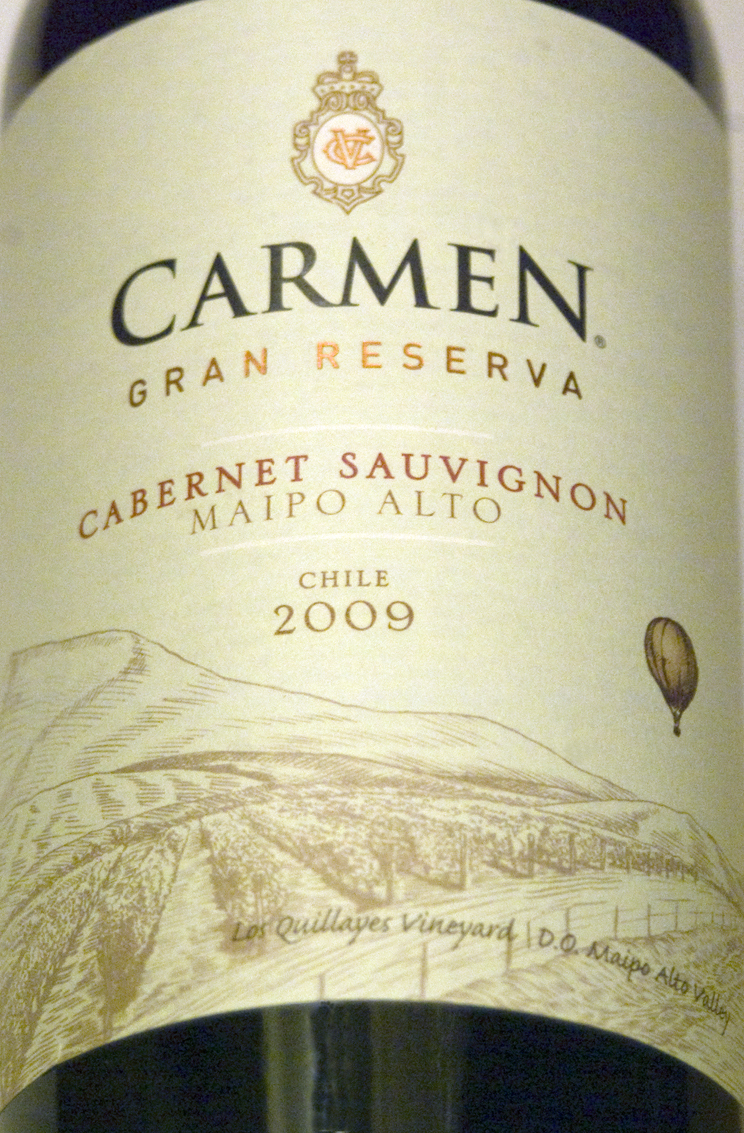
A Solid One-Two Punch from Carmen


I've thoroughly enjoyed the wines of Carmen, Chile's oldest wine producing company, since I was first introduced to them a little more than a decade ago. From the medium-priced riserva line of wines to the premium Gold Label offerings, this winery has always delivered the goods.

I've recently tried the new releases from Carmen, which have seen a new label design for the Gran Riserva wines as well as a new national importer, Trinchero Wine Estates from California. There are six wines in the Gran Riserva line, which represent Carmen's dedication to the various terriors of Chile. Thus the Chardonnay is made from grapes sourced from Casablanca Valley, while the Sauvignon Blanc is from the cool Leyda Valley, only a few miles from the Pacific Ocean.

The Carmenere comes from estate vineyards in Colchagua Valley, a few hours south of Santiago, while the other reds (Cabernet Sauvignon, Merlot and Petite Sirah) are all sourced from Carmen's beautiful hillside estate in the Alto Maipo, about a 45-minute drive southeast of Santiago.

My two favorite wines in the Gran Riserva lineup are the Cabernet Sauvignon and the Merlot, both from the 2009 vintage. Of course, the Alto Maipo is famous for Cabernet Sauvignon, as the wines here have good richness, lovely varietal character as well as soft tannins, which gives them an immediate drinkability. This Cabernet Sauvignon has good persistence and balance and along with the textbook varietal flavors of blackcurrant and red cherry, there are also notes of tobacco and dark chocolate.

The Merlot is the real surprise, however. Merlot gets a lot of bad publicity these days for various reasons, but if more were made like this, you'd read a lot more positive notices for the grape variety. Black cherry and black plum fruit dominate this wine and the tannins are polished as you might expect. This is very drinkable now and will be a fine partner for most red meats - especially lamb - for the next 2-3 years. Both of these wines are $15 retail (all the Gran Riserva wines sell at the same price) and these two reds in particular are excellent values.


Carmen has also released the 2007 vintage of their top red, the Gold Label Cabernet Sauvignon. I've been enjoying releases of this wine for the past six or seven vintages and have rated this wine as either excellent or outstanding every year. The wine is made from a beautifully sited vineyard that was planted in 1957; thus this 2007 release is from 50-year old fruit! Yields are low, the fruit is deeply concentrated on the palate and there is excellent persistence. As you might imagine, a wine this rich and young needs a bit of time in the bottle; I enjoyed this for dinner the other night at Al Dente restaurant in Chicago with a pork chop with poblano and red peppers, portobello mushroom and chipotle tomato coulis and as you might imagine, it was a heavenly pairing! The wine definitely needs at least 60-90 minutes of breathing time for enjoyment for dinner tonight; however the wine is just an infant and will improve for another 10-12 years, when it will be at its best.

The price on this gorgeous Maipo Valley Cabernet Sauvignon from Carmen is $50. I can guarantee you that a Cabernet Sauvignon made from 50-year old vineyards in Napa Valley would cost you at least $75 and probably more like $100 or $125 a bottle. This is another excellent value.

Here's to the consistency of Carmen wines, be it at $15 or $50 a bottle. This remains one of Chile's finest producers, I'm quite pleased to say!

Monday, December 19, 2011

A True Classic from Napa Valley

Mayacamas Winery, located 2000 feet above the Napa Valley floor


Throughout Europe, the wine producers that are discussed in great detail are the ones that have been producing their offerings for many years. While you do hear about new estates from time to time, it's the firms that have been around for decades or even centuries that are something of a reference point in Italy, France and other European countries.

Yet in California - especially in Napa Valley, it's the newest of producers that receive most of the headlines, while the wineries that have been around for 30 or 40 years (admittedly, a long time in Napa Valley history), seem to be overlooked. Think about it, you hear about the latest hotshots from Napa all the time, but when's the last time you read an article about a winery such as Joseph Phelps or Sterling? Did their wines suddenly decrease in quality? The answer is no, but these companies are not as fascinating or hip to many of today's wine writers, who are always looking for the newest viticultural temple funded by some multi-millionaire who hires the most expensive - and cult-driven - winemaker available.

So, I'm quite pleased to sing the praises of a real Napa Valley veteran- Mayacamas Vineyards. The winery was established way back in 1968 (talk about ancient history for this part of the viticultural world!) by Bob Travers, who today, is still making the wines. Named for the mountain range that serves as a border between Napa and Sonoma, the winery is situated some 2000 feet above the Napa Valley floor. This is a hidden gem, located in a place where coyotes, cougars and bobcats dwell. The vineyards, located at elevations ranging from 1800 to 2300 feet above sea level naturally yield very small crops, ensuring wines of structure for long-term aging.


Vineyards at Mayacamas


The other night I tried the current release of the winery's signature Cabernet Sauvignon from the 2006 vintage. Blended with 14% Merlot and 1% Cabernet Franc, this is a mouth-filling wine. But lest you think this is a typical blockbuster Napa Valley Cabernet Sauvignon, consider several things. First, the wine is aged for 18 months in large American oak casks and then 12 months in French 60-gallon oak barrels. This is quite different from the standard practice these days in Napa, where many producers use only French barriques (225-liter) for an aging period of 14-20 months. By using larger barrels for his wines, Travers focuses on the special fruit flavors he derives from his vineyards; my notes on the wine focus on perfumes of black currant, eucalyptus and blackberry. 

The wine has a beautifully developed mid-palate with layers of fruit while the finish is quite long with excellent persistence, good acidity and nicely integrated oak. The overall balance is ideal and the complexity is marvelous. My best guess is that the wine will improve dramatically over the next few years and be at its best in 12-15 years. The price is $65 a bottle and when you consider all the $100- $150 bottles of Napa Valley Cabernet Sauvignon out there (especially from the new hotshots), this is an excellent value (consider also that less than 1400 cases of this wine were produced). I'd even be tempted to call the $65 price tag for a wine of this breeding and class a real steal!

Bob Travers, here's to you during this holiday season for continuing to produce classic Napa Valley Cabernet Sauvignon for more than 40 years and for maintaining a sane price point. It's a lesson some of the new kids on the block need to learn.