Views on wines from Italy, California, Chile, Argentina and other great regions of the world from a freelance writer and photographer
Showing posts with label carmen. Show all posts
Tuesday, December 20, 2011
A Solid One-Two Punch from Carmen
I've thoroughly enjoyed the wines of Carmen, Chile's oldest wine producing company, since I was first introduced to them a little more than a decade ago. From the medium-priced riserva line of wines to the premium Gold Label offerings, this winery has always delivered the goods.
I've recently tried the new releases from Carmen, which have seen a new label design for the Gran Riserva wines as well as a new national importer, Trinchero Wine Estates from California. There are six wines in the Gran Riserva line, which represent Carmen's dedication to the various terriors of Chile. Thus the Chardonnay is made from grapes sourced from Casablanca Valley, while the Sauvignon Blanc is from the cool Leyda Valley, only a few miles from the Pacific Ocean.
The Carmenere comes from estate vineyards in Colchagua Valley, a few hours south of Santiago, while the other reds (Cabernet Sauvignon, Merlot and Petite Sirah) are all sourced from Carmen's beautiful hillside estate in the Alto Maipo, about a 45-minute drive southeast of Santiago.
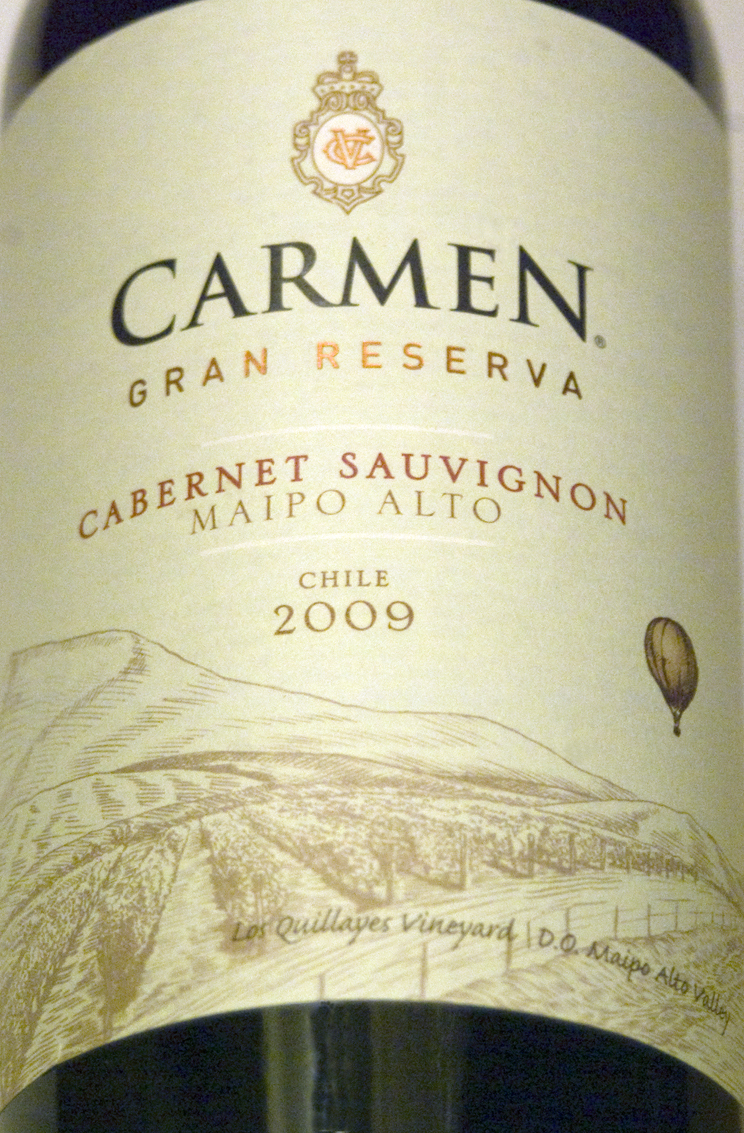
My two favorite wines in the Gran Riserva lineup are the Cabernet Sauvignon and the Merlot, both from the 2009 vintage. Of course, the Alto Maipo is famous for Cabernet Sauvignon, as the wines here have good richness, lovely varietal character as well as soft tannins, which gives them an immediate drinkability. This Cabernet Sauvignon has good persistence and balance and along with the textbook varietal flavors of blackcurrant and red cherry, there are also notes of tobacco and dark chocolate.
The Merlot is the real surprise, however. Merlot gets a lot of bad publicity these days for various reasons, but if more were made like this, you'd read a lot more positive notices for the grape variety. Black cherry and black plum fruit dominate this wine and the tannins are polished as you might expect. This is very drinkable now and will be a fine partner for most red meats - especially lamb - for the next 2-3 years. Both of these wines are $15 retail (all the Gran Riserva wines sell at the same price) and these two reds in particular are excellent values.
Carmen has also released the 2007 vintage of their top red, the Gold Label Cabernet Sauvignon. I've been enjoying releases of this wine for the past six or seven vintages and have rated this wine as either excellent or outstanding every year. The wine is made from a beautifully sited vineyard that was planted in 1957; thus this 2007 release is from 50-year old fruit! Yields are low, the fruit is deeply concentrated on the palate and there is excellent persistence. As you might imagine, a wine this rich and young needs a bit of time in the bottle; I enjoyed this for dinner the other night at Al Dente restaurant in Chicago with a pork chop with poblano and red peppers, portobello mushroom and chipotle tomato coulis and as you might imagine, it was a heavenly pairing! The wine definitely needs at least 60-90 minutes of breathing time for enjoyment for dinner tonight; however the wine is just an infant and will improve for another 10-12 years, when it will be at its best.
The price on this gorgeous Maipo Valley Cabernet Sauvignon from Carmen is $50. I can guarantee you that a Cabernet Sauvignon made from 50-year old vineyards in Napa Valley would cost you at least $75 and probably more like $100 or $125 a bottle. This is another excellent value.
Here's to the consistency of Carmen wines, be it at $15 or $50 a bottle. This remains one of Chile's finest producers, I'm quite pleased to say!
Saturday, April 9, 2011
Promising News from Carmen
Cabernet Vineyard at Carmen Estate, Alto Maipo (Photo ©Tom Hyland)
A few days ago, I opened a bottle of the 2005 Carmen Winemaker's Reserve Red, if for no other reason than to pair with some comfort food with a friend. I loved the wine when it was released and wanted to see how it was drinking after a couple of years. This full-bodied blend of Cabernet Sauvignon, Carmenere and Petite Syrah is a gorgeous wine, with its striking deep purple color, intense black currant, black plum and cherry and tar aromas and outstanding concentration. This is a wine with beautiful structure and balance backed by firm, but elegant tannins. While the wine is appealing now for its hedonistic pleasures, it's still an infant and has only started to show its greater complexities. Look for this wine to be at its best in another 10-12 years, though it may drink well in another 20 years.
I mention this wine not only because I loved it, but because you should realize that for a little while at least, you won't be able to buy this wine in the United States, as it's not being imported. Neither is the winery's brilliant Gold Reserve Cabernet Sauvignon, sourced from 40 plus year-old vineyards at the winery's Alto Jahuel estate in Alto Maipo, a prestigious address for Chilean Cabernet Sauvignon, if there ever was one. The fact that these wines sold for $50-$65 have something to do with it, but let me explain further, as there is promising news from Carmen regarding the availability of their wines in the United States.
Carmen has made a change in distribution for the US market and is now going with Trinchero in Napa Valley to represent their wines. The winery believes they will be able to do a much better job than their previous importer (I will not mention their name so as not to embarrass anyone), a company that was much smaller than Trinchero. Carmen worked with this former importer and focused on selling their Classic tier wines ($8.99 retail for such wines as Cabernet Sauvignon, Chardonnay, Sauvignon Blanc, et al) as well as their Reserva wines ($14.99 to $16.99, depending on the state - wines such as Cabernet Sauvignon, Sauvignon Blanc and Carmenere/Cabernet Sauvignon). Because of this focus, the Winemaker's Reserve Red and Gold Reserve Cabernet Sauvignon became much less of a focus, as they tried to work with their importer to boost sales on the other wines.
Ultimately the winery decided to make the change of importers and with it, a restyling of wines as well. The new offerings, arriving in the US within a few weeks, will be the Gran Riserva wines, focusing on the best terroirs in Chile; thus we will see Cabernet Sauvignon from Alto Maipo, Sauvignon Blanc from Leyda Valley, Chardonnay from Casablanca, Carmenere from Apalta as well as a few other wines. The pricing will be a very reasonable $14.99 per bottle.
I haven't tasted these new wines yet, but given the track record that Carmen has built up over the years, I am excited to sample them when they arrive. I was a big fan of the Reserve wines, especially the Cabernet Sauvignon and Merlot, as the wines offered beautiful varietal character, excellent structure and ideal balance. Best, they were appealing wines with food and offered the character you would normally find in wines that were in the $20-28 range, instead of the mid-teens. So given my pleasant experiences with Carmen's mid-tier wines in the past, I'm quite confident the winery will be delivering some beautiful wines for $15 with these new Gran Riserva offerings.
I've also learned that after a short time if things go well with these new wines, the Winemaker's Reserve Red may be brought back for the American market. I sure hope that's true, as I love the wine, but more importantly, that was the last bottle I drank the other day - I need more in my cellar!
Monday, November 23, 2009
Carmenère turns 15 - at least by its proper name
Vineyards of Carmen Winery, Maipo Valley
(Photo ©Tom Hyland)
The 15th anniversary of Carmenère
Happy 15th Birthday to Carmenère! Or maybe I should say, Happy Discovery Day, for it was 15 years ago – on November 24th, 1994, to be exact - that the Carmenère grape was correctly idenitifed in Chile by the French ampelographer, Jean Michael Boursiquot.
Carmenère was brought to Chile from France when phylloxera devastated the vineyards in Bordeaux in the second half of the 1800s. As the grape did not provide a meaningful part of the finest Bordeaux wines, most growers gave up on it when they replanted their vineyards. As Chile had a phylloxera-free environment, Carmenère and several other grapes from Bordeaux were introduced to Chilean soil.
However for years, most growers thought the grape was Merlot and treated it as such. Finally, some 15 years ago, the mistake was corrected and since then, there has been greater research conducted with this variety. For a while, it was named Grand Vidure (Carmen in Maipo Valley was one of the first to identify the grape as such), but today all producers label the variety as Carmenère.
Given its higher acidity and more pronounced spice than Merlot, it is surprising that Carmenère was incorrectly identified for such a long time. Because of this mistake, the grape was probably planted in some areas that were wrong for the variety. Carmenère needs a warmer climate, as underripe examples are green and overly herbaceous. Today many of the finest plantings are from Colchagua Valley and Maipo Valley.
Here are notes on a few bottlings of Carmenère available in the market today, both as monovarietal bottings along with a few examples blended with other red grapes:
GOOD
2008 HACIENDA ARAUCANO Carmenère (Valle de Colchagua) - François Lurton
Deep ruby red-light purple with aromas of ripe black plum and tobacco. Medium-bodied, this has a spicy finish (tobacco, clove) with moderate tannins and slightly tangy acidity. Enjoy this over the next 1-2 years. ($12)
2008 MONTGRAS Carmenère Reserva (Colchagua Valley)
Bright ruby red with aromas of black plum and dried flowers. Medium-bodied, this has tasty plum fruit and notes of black licorice in the finish. Enjoy this easy-drinking wine over the next 1-2 years. ($12)
VERY GOOD
2006 CASA SILVA Carmenère Reserva (Colchagua Valley)
Bright ruby red with aromas of black cherry, coriander, black pepper and vanilla. Medium-full with very good concentration. Rich mid-palate. Big finish with medium weight tannins, ample oak and balanced acidity. Give this a bit of time to settle down. Good varietal character, but a bit too much oak and alcohol. Best in 5-7 years. ($12)
2007 TERRA ANDINA Carmenère (Rapel Valley)
Beautiful bright purple with aromas of black plum and notes of black pepper and clove. Medium-bodied, this is tasty with a finish that has elegant tannins and very good persistence. Very nice value for only $13.
2007 MONT GRAS ANTU NINQUEN Cabernet Sauvignon/Carmenère (Colchagua Valley)
A blend of 70% Cabernet Sauvignon and 30% Carmenère. Black currant, blackberry and vanilla aromas. Medium-full, this is rich on the palate and has a lengthy tannins with robust tannins, ample oak and balanced tannins. Give this time to settle down – best in 5-7 years. ($19)
EXCELLENT
2006 CARMEN Carmenère-Cabernet Sauvignon Reserva (Maipo Valley)
Bright ruby red with aromas of sage, black pepper, cherry and menthol. Medium-full wth very good concentration, sensual flavors of vanilla and black cherry and a lengthy, well-balanced finish with harmonious tannins and good acidity. Good varietal character without the bittnerness you might expect. Enjoy over the next 3-5 years. ($20)
2006 CASA SILVA Carmenère Reserva “Los Lingues” (Colchagua Valley)
Deep ruby red-light purple with aromas of black plum, myrtle and clove. Medium-full with excellent concentration. Rich mid-palate and excellent fruit persistence. Youthful tannins, ample oak and balanced acidity. I’d like to see a bit less oak, but otherwise this is an impressive wine that should be at its best in 7-10 years. ($24)
2007 SANTA RITA Carmenère "Medalla Real" (Colchagua)
Bright purple with aromas of black plum, molasses, black licorice and vanilla. Medium-full with very good to excellent concentration. Rich mid-palate, round, elegant tannins and wonderful varietal character. Best over the next 5-7 years. Excellent value at $20 (and perhaps less in some markets).
2007 MONTES “ALPHA” Carmenère “Marchigue Vineyard” (D.O. Colchagua)
Deep ruby red-light purple. Aromas of black cherry, black raspberry and black plum preserves. Medium-full with very good concentration. Ripe and forward, but nicely balanced with appropriate oak and acidity and supple tannins. A pleasant note of black pepper in the finish. A very appealing wine to be enjoyed over the next 3-5 years with leg of lamb or grilled pork loin. ($24)

OUTSTANDING
2005 CARMEN Winemaker’s Reserve Red (Maipo Valley)
A blend of 50% Cabernet Sauvignon, 25% Carmenère and 25% Petite Syrah. Deep ruby red-light purple with aromas of tar, blackcurrant, black peppercorn and hints of bitter chocolate. Medium-full with excellent concentration. Elegant entry on the palate and a long finish with silky tannins, lively acidity and nicely integrated oak. Very classy! Elegant through and through, enjoy this over the next 12-15 years. ($44)
2005 HACIENDA ARAUCANO Carmenère “Alka” (Colchagua Valley)
100% Carmenère from vines with an average age of 40 years. Bright ruby red with beautiful aromas of morellino cherry and lavender. Medium-full, this is a beautifully structured Carmenère with lively acidity, subtle oak and fine grain tannins. The lengthy finish features notes of tar, mincemeat and orange zest. This is notable not only for its varietal purity, but also for its finesse. A few producers have turned up the volume of oak with their bottlings of Carmenère, whlie the Lurtons have opted for a more subdued approach with their oak. First-rate, this is approachable now thanks to its elegance, but will be at its best in 10-12 years. ($60)
Labels:
alka,
carmen,
Carmenère,
casa silva,
colchagua valley,
maipo valley,
mont gras,
montes,
santa rita
Tuesday, November 17, 2009
Values from Chile
Sign identifying Sauvignon Blanc Clone 242 in a Leyda Valley vineyard
(Photo ©Tom Hyland)
I love the wines of Chile and I’ve done my share of writing about the qualities of this country’s efforts, especially with the vibrant white wines of San Antonio and Leyda as well as the gorgeous reds from Maipo and Colchagua Valleys. These wines represent the upper tier of Chile’s wines and frankly are not as well-known as they should be.
What everyone knows about Chile are the moderately priced wines that are well made and offer fine values. While I don’t want to perpetuate a myth that Chile only produces these values offerings, well, I don’t want to dismiss these wines either, especially today, when so many people have to save money to make it through difficult times. So here is a brief list of some notable values from Chile.
2008 Leyda Sauvignon Blanc “Classic” (Leyda Valley)
Close by the Pacific Ocean, San Antonio Valley and the sub-zone Leyda Valley have become the home of some amazing examples of Sauvignon Blanc. Here is one of the finest values from this area; a wine that offers aromas of grapefruit and Anjou pear, has good richness along with lively acidity and textbook varietal flavors. A great match for shrimp and clams, this is a great way to discover the characteristics of Sauvignon Blanc from Leyda Valley and is an amazing value at $12! I can’t imagine a better example of Sauvignon Blanc for the price from anywhere in the world.
2008 Carmen Sauvignon Blanc Reserva (Casablanca Valley)
This has been one of my favorite Chilean Sauvignon Blancs for some time and the 2008 is another lovely bottling. This has a nice note of spearmint along with flavors of lime and grapefruit and is very round and elegant in the finish with cleansing acidity and excellent depth of fruit. Drink over the next 2-3 years with sautéed shrimp or risotto. ($16)
2008 Santa Rita Chardonnay “Medalla Real” (Limarí Valley)
The grapes for this wine come from the cool northwestern zone of Limarí Valley, only a few miles from the Pacific Ocean. Beautiful lemon custard, spiced pear and ginger aromas with tropical fruit flavors on the palate, this is quite rich with nicely integrated oak and a rich, lightly spicy finish. Enjoy over the next 2-3 years with a variety of seafood, from tilapia to sea bass. ($16)
2007 Calcu (Colchagua Valley)
Here is an excellent blended red from Colchagua Valley, home to so many flavorful, bold offerings. A mix of 50% Cabernet Sauvignon, 30% Carmenere, 15% Cabernet Franc and 5% Petit Verdot, this has plenty of red cherry and currant fruit along with notes of red pepper. Medium-bodied with tart acidity, this has moderate tannins and a clean, round finish. A fine match for most red meats or stews over the next 2-3 years. A steal at $12!
2007 Ventisquero Cabernet Sauvignon/Carmenere (Colchagua)
This blend of 70% Cabernet Sauvignon/30% Carmenere is a nicely balaned, middle-weight red with red cherry, cedar and sage aromas. This is not a powerhouse, but a nicely styled, subtle offering for foods such as pork chops, grilled meats or ligher game over the next 2-3 years. ($12)
2005 Maycas Cabernet Sauvignon (Limarí Valley)
At $23, this is priced higher than some consumers want to spend for a value wine, but to me that word is relative; this is a wonderful value. Deep ruby red, this has perfectly ripe black currant fruit with notes of menthol and subtle oak. The tannins are refined and ultra smooth, giving this wine a graceful and elegant finish. This has ideal strucure for aging another 5-7 years (or perhaps even longer). While filet is a natural match, I love this with roast duck, especially with the big fruit flavors of this wine. Mouthfilling and delicious, this is a great success and proof that a cool climate such as Limarí can be an ideal zone for Cabernet Sauvignon.
Labels:
carmen,
casablanca valley,
chilean wines,
leyda valley,
maycas,
santa rita,
ventisquero
Thursday, July 23, 2009
Chilean Sauvignon Blanc- Reaching Greatness
Sauvignon Blanc Vineyard of Santa Rita, Leyda Valley
(Photo ©Tom Hyland)
In the July 22 edition of the New York Times, Eric Asimov contributed a column entitled, “Summer’s Background Music.” Asimov, an excellent wine writer who doesn’t take himself or his subject too seriously, wrote about the simple pleasure of South American Sauvignon Blancs (primarily offerings from Chile) and how these attractively priced wines (many less than $16) make for nice “summer sippers.”
The article is fine and it gives readers a shopping list of some very good Chilean Sauvignon Blancs, many from the cool climate areas of Casablanca and San Antonio Valleys. Yet I have to take Asimov to task a bit here for what he did not say in the article.
Basically, what many consumers will take away from this article is that Chilean Sauvignon Blancs are nice wines, but little more than summer sippers. Yes, there are many examples of well made bottlings of this type of wine from Chile that are priced between $10-15 that are ideal for lighter fare and should be consumed sooner than later. Examples of this include the Montes and Veramonte, which scored well in the paper’s tastings as well as the Santa Rita 120 (I have no idea if this was one of the 20 wines tasted or not).
But one of the most exciting developments in the wine industry over the past five to seven years has been the dramatic increase in complexity and quality of Chilean Sauvignon Blancs. In fact, Sauvignon Blancs from the Southern Hemisphere have been quite a revelation lately, especially those from New Zealand (duly noted about everywhere) and South Africa.
Vintners in Chile have taken their game to the next level over the past decade, as they have begun to search for the proper microclimates in which to plant particular varieties. In this respect, they are similar to the vintners of California in the early 1990s, when areas such as the Santa Lucia Highlands in Monterey and Sta. Rita Hills in Santa Barbara County were targeted for Pinot Noir; these are now two of the most sought-after areas for this variety in California. (This is just one example- there are many in California and elsewhere.)
The same is now true in Chile, as Sauvignon Blanc is now being planted in the cool zones of Casablanca, Leyda and San Antonio Valleys. These valleys are west of Santiago and thus much closer to the Pacific Ocean, meaning the hot Chilean sun that ripens the grapes is moderated by the coastal breezes. Thus an ideal mix for Sauvignon Blanc with great flavor as well as vibrant acidity.
The Casablanca examples from wineries such as Pablo Morandé, Kingston, Santa Rita and Carmen are first-rate, offering lovely melon and spearmint fruit, usually unhindered by oak. These are from excellent sites and are farmed to low yields in order to increase concentration; while these are approachable upon release, these tend to drink well for 3-5 years.
The best examples from San Antonio and Leyda are the real revelations of Chilean Sauvignon Blanc, as they are quite intense and offer beautifully structured finishes and lovely complexity. These characteristics come from the fact that yields here are generally quite low (less than 3 tons per acre and often less) and that the vineyards are within five miles of the Pacific. In fact, the Sauvginon Blanc vineyards of Casa Marin are within 2 miles of the ocean; she told me that others thought she was crazy to do this, but she has persisted and has become one of the world’s great producers of Sauvignon Blancs.
The EQ from Matetic and the Casa Marin “Cipreses Vineyard” Sauvignon Blanc were tasted for the Times article and did score well. It’s great that these wines were included, if only to give them some notoriety. But I think that including them in a “summer sipper” article does these wines a great injustice. I actually have to wonder why the Casa Marin “Cipreses” bottling was included, as this is anything but a light, refreshing sipper. This is an intensely flavored, assertive, layered Sauvignon Blanc with piercing acidity and a lengthy finish. I think of summer sippers as something to accompany lighter fare, such as salads or simple sautéed shrimp, while this Casa Marin bottling is big enough to stand up to halibut, sea bass and even roasted chicken or pork medallions.
Maria Luz Marin has been producing this wine since 2003 from her vineyards and the style today if anything is a touch lighter than at first (she admitted to me that the initial 2003 offering was “too much”). In fact, if one were to choose a Casa Marin Sauvignon Blanc for a tasting like the Times organized, the proper choice would have been the “Laurel Vineyard” bottling, which is more fruit-oriented and less forceful than the “Cipreses,” although it is still a big, complex wine. (I wonder if Tasting Coordinator Bernard Kirsch knew this when he selected the wines for this grouping.) I also think that the relatively conservative rating of 2 and 1/2 stars for this wine had to do with the fact that it is so robust in style; after all, if you’re looking for a summer sipper, you’re bound to be thrown for a loop with a wine like this.
For my own evidence, I tasted several excellent to outstanding Chilean Sauvignon Blancs on a recent trip there. Tasting notes are below. I had tasted most of these before and had fallen in love with the overall quality and distinctive style of these wines. On this trip I also discovered a great wine from a relatively new project called Maycas, produced by Concha y Toro from grapes in the northern region of Limarí Valley. There are a few other excellent Sauvignon Blancs from here, especially Tabalí, while Santa Rita has recently planted the variety here for their Sauvignon Blanc program. The Maycas is extraordinary Sauvignon Blanc (both the 2007 and the currently available 2008) and is a steal at $21.
Chilean Sauvignon Blanc
2008 Santa Rita “Medalla Real” (Valle de Leyda)
Aromas of melon, bell pepper and Bosc pear; medium-full with a beautiful texture on the palate. Very good acidity and excellent fruit persistence. Quite delicious with wonderful complexity. These vineyards are only five miles from the Pacific Ocean and are quite shallow, ensuring low yields. Enjoy over the next 3-5 years. ($16) Excellent
2008 Carmen Reserve (Casablanca Valley)
Rich aromas of spearmint, lime and grapefruit – nice varietal intensity. Medium-full, this has beautiful acidity and a light herbal touch. Quite delicious! Enjoy over the next 2-3 years. ($16) Excellent
2008 Maycas (Limarí Valley)
Intense aromas of green pepper, asparagus and spearmint. Medium-full with excellent concentration. Rich, generous mid-palate; long finish with vibrant acidity and beautiful fruit persistence. Gorgeous wine with great varietal character. Enjoy over the next 2-3 years. ($23) Outstanding
2008 Casa Marin “Laurel Vineyard” (San Antonio Valley)
Beautiful aromas of gooseberry, lime and grapefruit. Medium-full with excellent concentration. Vibrant acidity and a long, beautifully structured finish with great fruit persistence. Lovely wine with great varietal purity. Enjoy over the next 3-5 years. ($28) Oustanding
2008 Casa Marin “Cipreses Vineyard” (San Antonio Valley)
Persistent aromas of gooseberry and bell pepper. Medium-full with excellent concentration. Vibrant acidity and a long finish with excellent fruit persistence. This is an assertive style of Sauvignon Blanc and compares favorably with many of the top Sancerres and bottlings from New Zealand. This vineyard is less than two miles from the ocean- a razor’s edge climate that provides great intensity and pronounced aromatics. Enjoy over the next 3-5 years. ($28) Oustanding
Casa Marin Sauvignon Blanc - Laurel and Cipreses Vineyards (Photo ©Tom Hyland)
I also recently tasted the 2006 Cono Sur “20 Barrels” from Casablanca Valley. Offering aromas of spearmint, honeydew melon and dried yellow flowers, this has great texture and richness on the palate and is aging beautifully; it’s great now and should offer pleasure for another two years or so. There are many more wonderful Sauvignon Blancs from Chile I’m excited to try- consumers should do the same!
Finally, a note to Eric Asimov. Having read your column for some time now, I know you love Sauvignon Blanc and I've enjoyed your defense of this grape with excellent columns on Sancerre and New Zealand. I hope you’ll try more of these upper tier Sauvignon Blancs from Chile and write an article about them. I’d love to see you spread the word that these wines are certainly more then refreshing offerings for warm weather - they’re among the finest white wines made today!
Monday, June 8, 2009
Chilean Seafood and Sauvignon Blanc

Camarones de orilla, Hacienda Santa Cristina, Limarí Valley, Chile
Text and photos ©Tom Hyland
During a recent visit to Chile, I commented to my friend Hector, a native Chilean, that I thought his country has the finest seafood in the world. His comment was that France has better oysters, but otherwise he agreed with me.
I don’t care for oysters, sorry to say, but as far as just about every other type of seafood, Chile rates number one on my list. You may find a better abalone in Monterey or better clams from the Gulf of Napoli, but overall, no one – not even New Zealand - beats Chile. (A delightful woman I recently met from Hong Kong votes for her land, so maybe I’ll have to head there soon to see if I’ll change my mind – but for now, it’s Chile.)
Now it’s one thing for my Chilean friend to stick up for his homeland, but in this instance, he had a great reason to do so. He explained to me that Chile is the beneficiary of the Humboldt Current, which comes up the Pacific from Antarctica. This is a very cold current, meaning the fish that do reside in waters off the shore are hearty, meaty creatures.
A great example is mero, which I tried this for the first time three years ago at a winery restaurant in the Casablanca Valley. My host, Pablo Morandé, asked me if I had ever tasted it and when I told him I had not, he explained to me that this was the real Chilean seabass. He noted that many restaurants in Santiago and other cities in Chile serve seabass that was caught just off the coast; this is good, but not great seafood. Mero, however, resides more than 10 miles off the coast in colder, deeper waters and is much meatier. He was absolutely right, as this was an incredibly rich, full-flavored, tender piece of fish that melted in my mouth like butter. You don’t see Mero on many menus in America, but if you do, go for it, or else pay a visit to Chile for this remarkable dish. (By the way, any reports you may have heard about Chilean seabass – and some of that in America is actually from Alaska – does not refer to mero. This is not on any endangered list, nor is it being overfished).
Mero served atop a sushi roll stuffed with paella at Pablo Morandé winery restaurant, Casablanca Valley, Chile
On my trip in April, there were two great seafood meals I enjoyed. One was in the northern part of the country in the Limarí Valley, where I enjoyed a special type of shrimp known as camarones de orilla. These are river shrimp and are caught in the shallow rivers of the area and are often served at meals the same day. If you drive the main highway out of La Serena, you will see vendors waving these shrimp at cars passing by, selling the seafood they have just caught. We didn’t have time to stop and buy any from a local, but we did enjoy them – steamed – at a Hacienda Santa Cristina, a wonderful restaurant in the area.
Also at the outstanding Tanino restaurant located at the Casas del Bosque winery, my friend and I sampled two wonderful seafood dishes. He went for grilled mero with spaghetti, sauteed in arugula pesto and toasted almonds, while I opted for cannelloni stuffed with Chilean abalone and shrimp with a sauce of Chardonnay and Grana Padano cheese (like many Chilean restaurants, there is a major Italian influence in the cooking here at Tanino). Both were first-rate and great examples of the quality and flavor of Chilean seafood as well as the creativity of Chilean cuisine. I highly recommend Tanino when you visit the Casablanca Valley; this area has some of the finest restaurants in the country and this is one of the very best.
Cannelloni stuffed with Chilean abalone and shrimp with a sauce of Chardonnay and Grana Padano cheese, Tanino Restaurant, Casas del Bosque Winery, Casablanca Valley
As for the wines to accompany the various seafoods of Chile, my preferred choice is Chilean Sauvignon Blanc. For years, this was a category that was rather mundane (the use of plant material was the big drawback), but with the introduction of clones from France and California over the past ten years, the Sauvignon Blancs of Chile have become something of a revelation. Now that the vintners are seeking out cool climates such as Casablanca and Leyda Valleys for the variety, the wines display more complex aromatics along with lively acidity and the structure to age for as much as 3-5 years from the finest vintages.
Take the 2008 Sauvignon Blancs from Carmen or the Santa Rita Reserve, both from Casablanca Valley. Both wines offer beautiful spearmint and melon fruit with subtle grassy notes and have very good acidity. The 2008 Medalla Real bottling from Santa Rita is from Leyda, where the estate vineyards are only five miles from the ocean. This has more intensity in the nose (notes of pear and green pepper highlight the aromas) and slightly higher levels of acidity. Other very good to excellent examples from Casablanca include the 2008 Viña Casas del Bosque and the 2008 Morandé Reserva. What makes these wines even more attractive are the prices; all these wines can be found for $16 or less.
There are two special Chilean Sauvignon Blancs I want to mention as well, as these are among the very best I’ve had from the country. First is the Maycas Sauvignon Blanc from the Limarí Valley, which I tasted for the first time on my recent trip when I enjoyed the river shrimp I mentioned earlier. Maycas is a realtively new project of Concha y Toro and based merely on this one wine (there are also bottlings of Maycas Chardonnay, Cabernet Sauvignon and Syrah, all from Limarí), I’d say this is a great project. I tasted the 2007 that day and was blown away by the wine’s aromatics and intensity. From the first smell and sip, you realize you’re dealing with a serious Sauvignon Blanc; the wine offers deeply concentrated aromas of fennel, asparagus and green pepper along with ripe melon and grapefruit- it’s an amazing set of perfumes. Medium-full, the wine has great depth of fruit and striking acidity.
Maycas Sauvignon Blanc
2007 was a great year and sadly that wine is now all but gone from retail shelves. But I am pleased to report that the new 2008 is virtually the equal of the 2007. It’s less herbaceous in character, but with more fruit notes in the aroma and it’s slightly less powerful on the palate, but in terms of complexity, flavor and ability to age (3-5 years), it’s right there with the 2007. These two wines are great evidence that the Maycas Sauvignon Blancs are among the very best Chile has to offer. (Retail price in America is $23, a bit higher than the previously mentioned bottlings, but the Maycas Sauvignon Blanc is worth every penny.)
One other estate I want to focus on regarding Sauvignon Blanc is Casa Marin, owned by Maria Luz Marin, a dynamic woman who has spent many years working with other wines estates in Chile before establishing her own. Her estate is in the San Antonio Valley, a small sub-zone of Leyda; located extremely close to the ocean – one of Marin’s vineyards, Cipresses, is less than two miles from the Pacific; this is a razor’s edge climate.

Laurel and Cipresses Vineyard Sauvignon Blancs of Casa Marin
Some thought Marin was a bit crazy to try and plant vineyards so close to the coast, but she has proven these doubters wrong. She is producing lovely bottlings of Pinot Noir, Syrah (espcially elegant and supple), Riesling and Gewurztraminer, but her best wines year in and year out continue to be her two single vineyard offerings of Sauvignon Blanc, Cipresses and Laurel. The former, as it is from a vineyard closer to the sea, has more herbal, bell pepper and gooseberry notes, while the Laurel is a bit more tame, if you will, with flavors of lime and grapefruit to accompany the peppery notes. The 2008s are out now and they are outstanding wines with vibrant acidity and the structure to age for 3-5 years. These are priced higher than most examples of Chilean Sauvignon Blanc – around $30-$35 a bottle – but they are outstanding examples of how great this country’s white wines have become!
P.S. One other note on the Maycas and that has to do with the labels, which are some of the most creative I’ve ever seen. Maycas is a word from the language of the Quecha people meaning “ariable lands”; the Quecha were the foundation of the Inca Empire, one of South America’s most powerful civilizations. Along with having a beautiful font design, the label is a recreation of a calendar used by the Quecha in which a 10-day week known as a Junka was used as a measure of time. The label features drawings of turquoise counting stones that mark the length of time from grape harvest to final bottling. Neat concept!
Labels:
abalone,
carmen,
casa marin,
casas del bosque,
chile,
chilean seafood,
maycas,
mero,
morandé,
santa rita,
sauvignon blanc,
shrimp
Wednesday, May 6, 2009
Carmen - New Passion in the Alto Maipo

Cabernet Sauvignon vineyards at Carmen estate in the Alto Jahuel district of the Alto Maipo, Chile (Photo ©Tom Hyland)
No puedes hablar de pasión. Si no lo has probado.
You can’t talk about passion. You have to taste it. – Slogan for Carmen Winery
It’s a natural thought process to focus on what’s new and trendy and overlook an established commodity. The wine media does it all the time, so it may not be a surprise that you don’t hear much about Carmen Winery in Chile, as it was founded in 1850. But you’d be missing out on some gorgeous wines if you didn’t include Carmen in your list of the best Chilean wine estates.
This may be Chile’s oldest wine house, but there have been numerous changes over the past 25 years. The winery was purchased in 1987 by a new ownership group and a new winery was built in 1992 in the Alto Jahuel section of the Alto Maipo, southeast of Santiago. The Alto Maipo is a very different section of the Maipo Valley than the vineyards in the western reaches of the valley, where the more fertile soils yield pleasant, if unexciting wines. The Alto Maipo, with vineyards at elevations above 2000 feet, is an ideal spot for producing full-bodied wines with excellent acidity, as the cool nights at the high elevations assure proper backbone and structure in the wines. “This is the only place in the Maipo to make great Cabernet Sauvignon,” says Carmen chief winemaker Stefano Gandolini.
There are a few dozen estates that produce sumptuous reds here and Carmen is one of the finest. There are several lines of Carmen wines, starting with the classic bottlings in the $8-9 price range which are produced primarily from grapes grown in Chile’s Central Valley. What I’d like to focus on however are the Reserve wines along with the Winemaker’s Reserve wines as well as the Gold Reserve Cabernet Sauvignon
I won’t go into every wine here, but among the Reserve wines, three stand out in my mind. The 2008 Sauvignon Blanc Reserve (about $15 retail) has nice varietal intensity with flavors of grapefruit and a hint of lime, lively acidity and a long, richly flavored finish. What an ideal choice for ceviche, shrimp or scallops.
The 2006 Carménère-Cabernet Sauvignon Reserve ($16) has exotic aromas of menthol and oregano with rich black fruit flavors and notes of tobacco in the finish along with round tannins. This is quite elegant and is a perfect foil for most red meats; if you love South American cuisine, this is heavenly with empanadas!
My favorite Reserve is the Merlot ($16); given how boring most bottlings of Merlot are, this is saying something. The trick here is that the grapes are from Casablanca Valley, a much cooler region than Maipo. This means better acidity, which gives this wine excellent structure, freshness and a clean, bright finish. This is simply a delicious wine with tasty black cherry and red plum flavors and an elegance from start to finish. If only more Merlots were made with this amount of care! Foods for this- you name it! This is an important wine, not only because it’s well made, but because it’s a well-made Merlot for $16. I’d go out and buy several bottles or a case if I were you!
The 2007 Winemaker’s Reserve Chardonnay, also from Casablanca Valley, has Meursault-like qualities about it, with its rich fruit and notable spice. The flavors are quite attractive – pear, pineapple and quince and there’s just the right amount of oak along with a nice touch of minerality in the finish. This has another 2-3 years of life ahead of it and it’s a fine value at $25.
The 2005 Winemaker’s Reserve Red is a gorgeous blend of Cabernet Sauvignon, Carménère, Syrah, Merlot and Petite Sirah that is truly something special. Loaded with layers of fruit and boasting flavors of black plum, cassis and milk chocolate, this sports a lengthy finish with elegant tannins and beautiful structure. I see this wine aging well for as long as 12-15 years, making the $45 price tag a steal. How good this wine is with roast pork or most game dishes!
Gold Reserve Cabernet SauvignonFinally there is the 2005 Gold Reserve Cabernet Sauvignon produced from a single vineyard at the Alto Jahuel estate. This vineyard was planted in 1953; the wine displays the intensity and breeding of these old vines along with wonderful suppleness and structure. This is a powerful wine, yet at the same time beautifully balanced with an extremely long finish. It’s excellent now and may just turn out to be outstanding in 12-15 years; like any red wine of this caliber and strength, this needs time to settle down. The price is approximately $70 a bottle, which puts it on an equivalent level with the best red wines of the Alto Maipo.
So from an old, established winery, beautiful new wines. Congratulations to head winemaker Stefano Gandolini and the other member of his winemaking team, Sebastián Labbé and Alejandra Vallejo for their outstanding work!
Alejandra Vallejo, one of the winemakers at Carmen (Photo ©Tom Hyland)
Subscribe to:
Posts (Atom)


