Showing posts with label barbaresco. Show all posts

Monday, November 30, 2009

Out of Touch - Again

Serralunga d'Alba, one of Barolo's finest communes
Photo ©Tom Hyland


Wine appreciation is, at its most basic, an individual thing. What I think about one particular wine may not be in snyc with what you think. That’s fine – we can agree to disagree.

Yet along the way when wine lovers turn to someone for guidance, they want an accurate account of what certain wines have to offer. Again, you may disagree with one particular review, but for the big picture, you want the reality of the situation.

The December 15th issue of The Wine Spectator offers more evidence that James Suckling, who covers the Italian wine scene for the magazine, cannot be trusted to offer an accurate representation of that country’s wine industry.

This is nothing earth shattering, as Suckling has come up with some very strange accounts of Italian wines (more on that later), so this is just the latest in a string of faulty reports. But given the importance of this publication in many people’s eyes, it is worth reporting on.

This issue has Suckling’s take on the recently released bottlings of Barolo from the 2005 vintage. Basically, he has written that he slightly prefers this vintage to 2004. This may come as a shock to many who have had the experience of tasting a number of examples from each vintage. I am fortunate enough to taste more than 125 Barolos from every new vintage when the wines are presented for the worldwide press at the Alba Wines Exhibition, held in Alba each May, so I believe I am qualified to discuss this issue.

This year the 2005 Barolos were presented and overall, I thought the vintage was quite good, if a little uneven. As with every year, there are outstanding bottlings (Bartolo Mascarello, Francesco Rinaldi “Brunate”, e.g.), but there are not the sheer numbers of memorable wines as there were from 2004. That vintage was a classic, with excellent depth of fruit, beautifully defined structure and stunning aromatics. Many of the top bottlings of Barolo from 2004 can age for 20-25 years, in my opinion, while there are a few great bottlings that will peak at 35-40 years.

Comparing 2005, I think it is a very good vintage, as the wines have good depth of fruit and very good acidity. These are wines for the most part that will peak at 12-15 years after the vintage- a typical assessment on my part. Thus I’d give the 2005 vintage a rating of 3 stars (very good) while I awarded the 2004 vintage a rating of 5 stars or outstanding.

Others agree with me; one fellow journalist attending this event told me that the 2005 Barolos are nice wines to drink while you wait for the 2004s to come around. That’s pretty typical of what most journalists I spoke with thought of these wines – very nice, but hardly great and certainly not the equal of the 2004s.

Yet here comes Mr. Suckling professing his preference for the 2005s over the 2004s. Why? Basically he writes that the 2005s will offer more pleasure over the next decade. This is arguably true, as the wines are not as deeply concentrated, and thus are more approachable.

Yet, Suckling also writes that the 2004s will probably last longer than the 2005s when it comes to cellaring. Think about that! He admits that the 2004s will age longer, yet he prefers the 2005s. So what is he saying here? Basically he is saying that he likes more approachable wines when it comes to Barolo. Is this an accurate portrayal of what Barolo represents? Barolo is one of the world’s greatest reds, in large part, due to its aging potential as well as its ability to offer greater complexities and reveal more flavors as it ages. That’s a rare combination and one that should be prized.

For Suckling, Barolo can be a rich, powerful wine, but it can only be great if it is approachable at an early age. At least, that’s the best I can figure, given his ratings of recent Barolo vintages. His description of the 2000 vintage in Piemonte as a 100-point year (how ridiculous it is to rate a growing season on a 100-point scale?) is his most famous misrepresentation of Barolo. 2000 was a year that produced soft Barolos, ones with moderate acidity to go with the forward fruit. This easy-drinking vintage was in Suckling’s words, the “best ever” for Barolo, an absurd statement. Don’t take my word for it, ask any winemaker in Barolo about the 2000 vintage – you won’t find one who would even say that it was the best vintage in the last decade. So how can Suckling think that 2000 was the best vintage ever? (Further proof comes from tasting the wines – most are now at or nearly at peak and the fruit in many bottlings has dried out. Barolos peaking at 10-12 years of age? Hardly a description of greatness.)

You should realize that Suckling is an American living in Tuscany; it’s clear to me that he brings a California palate to Italian wines. He prefers a riper, more forward style of wine; thus a more traditionally made wine that has naturally high acidity with a subdued fruit profile is not something that he rewards with high scores. Winemakers in Piemonte call wines made in the fruit-forward style that Suckling prefers, “California Barolos”, referring for example to the wines from 1997 and 2000, two vintages Suckling lavished with high praise.

It’s easy to understand then that he is a fan of many Italian reds (especially Super Tuscans) that have little to do with the more classic approach of many Italian winemakers who respect the heritage and terroir of their land. (I could also argue that he favors wines of many of his friends in Tuscany, but I’ll save that for another day.)

Whether Suckling’s preference for forward, fruit-driven Italian wines is merely his preference or part of the requirement for any journalist at the Spectator is open to question, but let’s face it, his bias is all too obvious. Thus a classic vintage such as 2001 doesn’t get as high a rating as 2000, which is ridiculous- I don’t know how else to put it. And for 2005 to be rated as a better vintage than 2004 for Barolo, that’s more proof that long-lived Barolos aren’t what Suckling is looking for. That to me is not an honest portrayal of what Barolo is all about.
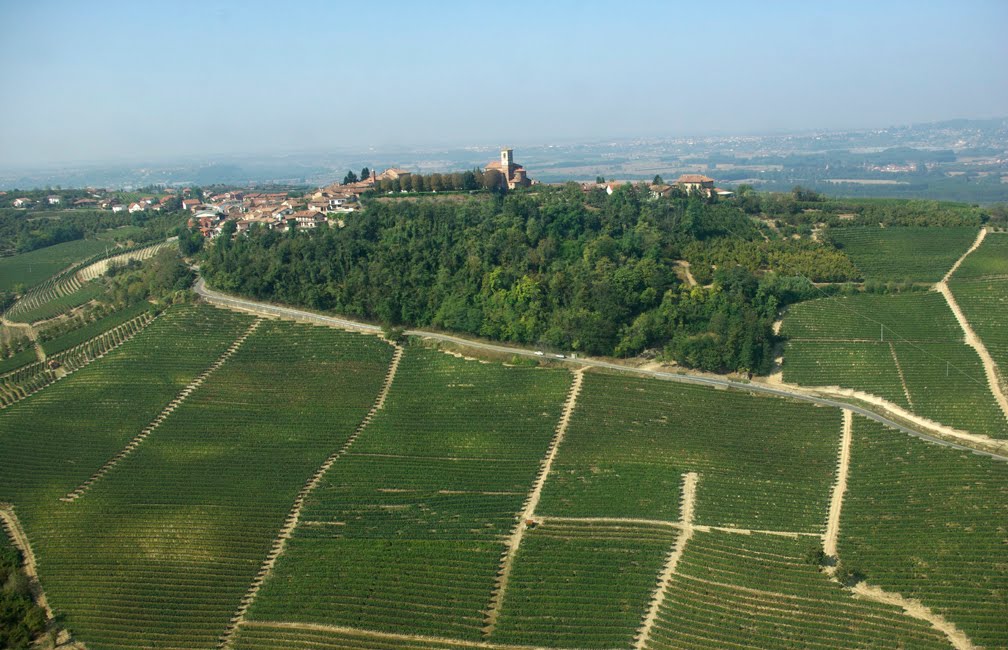
Vineyards at Verduno in the heart of the Barolo zone
Photo ©Tom Hyland


If this wasn’t bad enough, he also wrote a short piece on the 1999 Barolos and Barbarescos in this same issue. He writes that the 1999s were "never destined for greatness.” That did it for me! 1999 is an outstanding vintage as these wines offer excellent concentration as well as beautifully defined acidity, a combination winemakers – and wine drinkers – seek.

So why does Suckling believe that the 1999s are not great? According to his thinking, this wines are “lean.” Lean? The 1999s? He writes that they are not as concentrated as those from 1989, 1990, 1996 or 1997. He is arguably correct here, but does the fact that a vintage offers less depth of fruit that another mean it is not as good? What makes a Barolo or any wine great (and let me say here that the word great is overused by too many wine writers) is a combination of fruit, acidity, tannin and above all, balance. Bigger does not necessarily mean better. I have no problem with Suckling prefering the 1989, 1990 or 1996 vintage over 1999 (though I believe 1999 is far superior to 1997, as do many winemakers in Barolo), but to say that the 1999s from Barolo and Barbaresco aren’t great because they are not as intense as other vintages is futher proof of his misunderstanding of balance and structure as key roles in these wines. Callling the 1999s “lean” is like saying a 50-year old man who is 5’10” and weighs 175 pounds is lean. Compared to what, another 50-year old man of the same height who is 250 pounds? Maybe that man is overweight!

I’ve said it before and I’ll say it again – if you look to James Suckling for advice on Italian wines, you get what you deserve.

Thursday, January 15, 2009

The Pleasure of Tradition - Piemontese Style


I enjoyed lunch at Francesca’s on the north side of Chicago with my friend and fellow Italian wine lover Jeremy McMahon the other day. Jeremy’s only been in the wine business for a few years, but he’s already accomplished something I haven’t – he’s worked a harvest in Piemonte. How I envy him for that!

We talked about his experience over lunch. He worked for Paolo Sarocco for the Moscato harvest in Castiglione Tinella and after finishing that, Sarocco told him about a fine Barbaresco producer by the name of Pasquale Pelissero (also known as Cascina Crosa), located in the town of Neive. Jeremy went to work there and by the way he told his story, I could tell that he loved his time in the vineyards (especially tasting the ripe grapes) and was grateful for the kindness of the local vintners.

He brought a bottle of the 2005 Barbaresco “Bricco San Giuliano” from Pasquale Pelissero and it accompanied our lunch like it was meant specifically for our spinach and pastas. This is a textbook example of this wine; my notes describe the currant and persimmon aromas, rich concentration, subdued oak, lively acidity and graceful finish.

We both loved the wine for numerous reasons, most specifically because it was an elegant accompaniment to our food. There was clearly no thought on the part of the winemaker to fashion a “big” wine that would be awarded high scores in a wine magazine. Rather the winemaking here was respectful of the fact that whoever tried this wine would enjoy it with food.

This is a classic concept in Piemonte and throughout most of Italy that is not always respected these days. Too many estates (usually in other regions farther south than Piemonte) are pushing the ripeness of their grapes and crafting modern, forward, overblown wines meant to impress certain influential wine publications. As my friend Jeremy Parzen wrote to me in a recent email, “these producers have sold their soul for a score.”

There’s been plenty written about this trend by Jeremy, Franco Ziliani, Alfonso Cevola and many other wine journalists who respect tradition and terroir in Italian wines. There’s no need for me to add that much more except to say that we need to keep reminding consumers that there are differences between wines that overwhelm you (the wow factor) and the ones that try to delight you. Tradition in Italian wines is all about the simple pleasure of pairing a wine with the local foods. How nice that the people associated with Pasquale Pelissero as well as hundreds of other Piemontese producers understand that!

Wednesday, December 31, 2008

Favorite Italian Red Wines of the Year

Detail of the Sorano Vineyard of Ascheri in Serralunga d'Alba, source of one of the author's best bottlings of Barolo from this past year. (Photo ©Tom Hyland)


This year many of my top Italian reds centered on a common theme – they were from the glorious 2004 vintage. The Barolos from that year are stunning, the Amarones are polished and the bottlings of Taurasi are wonderfully concentrated with their typical charm. Throughout the country, 2004 was a remarkable success for Italian reds.

Here are my favorites (listed from north to south in Italy):

2004 BAROLOS
Rarely has there been a collection of Barolos with such deep fruit aromas, concentration of fruit and gorgeous acidity. There are so many great 2004 Barolos that I can’t list them all, but here are a few favorites: Fontanafredda “La Villa”, the least known, but most elegant of the three cru Barolos produced by this historic estate; Cascina Cucco “Vigna Cucco” and “Cerrati”, two beautifully supple bottlings from this small estate in Serralunga d’Alba; Ascheri “Sorano Coste e Bricco”, one of the most finesseful of all the 2004 Barolos and the Ettore Germano “Prapo”, a wine with vibrant spice backed by graceful tannins.

Also, the Elio Grasso “Vigna Chiniera”, a traditionally produced beauty from Monforte d’Alba; the powerful Aldo Conterno “Romirasco”, that displayed remarkable concentration and two beautifully structured offererings from Roberto Voerzio“Rocche dell’Annunziata Torriglione” and "Sarmassa". These wines are ultramodern in style as they are aged in barriques, yet the layers of fruit are the story and not the oak.

Finally, other top Barolos include Vietti “Rocche”; Rocche Costamagna “Bricco Francesco”, the finest bottling of this wine I’ve tasted to date; Luigi Baudana “Baudana”; Cogno “Ravera” from the commune of Novello and the Damilano “Liste” from the commune of Barolo.


Bruno Nada, winemaker at Fiorenzo Nada. He produced one of the author's top bottlings of Barbaresco from this past year. (Photo ©Tom Hyland)

2005 BARBARESCOS
Though less powerful than the bottlings from 2004, the Barbarescos from 2005 are equally impressive, at least for the best producers. Three wines take the top spots on my list: Fontanabianca “Sori Burdin” with its distinctive aromas of rose petals, cumin, allspice and dried orange peel; Fiorenzo Nada “Rombone” with its excellent fruit persistence, nicely styled tannins and lively acidity and finally the elegantly styled Rizzi “Boito” that offers plush aromas of red cherry, strawberry and red spice along with big fruit persistence and lively acidity. This is one of the most underrated producers in Piemonte and all of Italy!

2004 ANTOLINI AMARONE “MOROPIO”
This is a gorgeous Amarone that takes you back to the days when local producers concentrated more on elegance than power. This offers beautifully perfumed aromas of violets, black raspberry, a hint of chocolate, molasses and rum, is balanced throughout and has lovely acidity and subtle oak. I wish more producers made their Amarone in this style!

2004 TENUTA SANT’ANTONIO AMARONE “SELEZIONE ANTONIO CASTAGNEDI”
Although this is a bit more modern in style than the Antolini, this is still a lovely Amarone with great finesse. Big aromas of red cherry, coriander and tobacco and a lengthy finish- this is beautifully made. I prefer this wine to the riper, more powerful “Campo dei Gigli” bottling from this producer.

2005 TENUTA SAN GUIDO “SASSICAIA”
2005 TENUTA DELL’ ORNELLAIA “ORNELLAIA”

You might expect these selections from Bolgheri to be no-brainers and to some extent they are, but these are more impressive to me than their respective 2004 bottlings, as they offer more lively acidity and backbone. Some will prefer the 2004s for their power, but the 2005s aren’t exactly lighweights and I admire the overall balance of these wines from start to finish. Look for these wines to be at their peak in 15-20 years.

2005 TENUTA DI BISERNO “IL PINO”
Another Bolgheri red from a relatively new estate headed by Lodovico Antinori (formerly of Ornellaia) along with his brother Piero. This blend of Cabernet Franc, Cabernet Sauvignon, Merlot and Petit Verdot has explosive aromas, excellent fruit persistence and lively acidity and should be at its best in 10-12 years.

2005 MARINA CVETIC MONTEPULCIANO D’ABRUZZO
I listed this producer’s Trebbiano d’Abruzzo as one of my favorite whites of the year and this glorious red made by the Gianni Masciarelli (Marina’s husband who recently passed away) is one of my top reds. This is a flavorful wine with notes of tobacco and myrtle with lively acidity and a long finish- it’s simply delicious!

2004 MASTROBERARDINO TAURASI “RADICI”
Is there another producer of Taurasi that makes as flavorful – and at the same time – elegantly styled bottling than Mastroberardino? The winery’s approach with this 100% Aglianico really shines in a great vintage such as 2004. You get the textbook chocolate and cherry flavors, great fruit persistence and young, but balanced tannins. Look for this to be at its best in 15-20 years.

2005 MARISA CUOMO RAVELLO ROSSO RISERVA
Here is another winery that I included in my list of best whites of the year for its 2007 Furore Bianco “Fiorduva”; this lesser known wine also makes the list for best reds. A blend of 50% Aglianico and 50% Piedirosso aged in barriques, this is quite stylish with flavors of black cherry, licorice and tobacco backed by tart acidity. It’s not a powerhouse – it will be at its best in 5-7 years - but it is quite impressive!

2004 DUCA DI SALAPARUTA “DUCA ENRICO”
For some time now, this has been one of Sicily’s most complex and beautifully structured reds. Winemaker Carlo Casavecchia has produced one of his finest efforts to date with this gorgeous effort from 2004. 100% Nero d’Avola from vineyards near Gela in southeastern Sicily, this has inviting aromas of marascino cherry and fig backed by subtle oak, lively acidity and velvety tannins. This is an oustanding bottling of Duca Enrico; look for this to be at its peak in 12-15 years.


Please note that I did not list any bottlings of Brunello di Montalcino. This has nothing to do with the current situation in Montalcino, rather it has to do with the quality of the current releases from the 2003 vintage. Though there were some successes, overall the wines offer bitter tannins, robbing these wines of their usual elegance and finesse. Given that the 2004 bottlings of Brunello will be released in 2009, I expect several of these wines to be on my list of the Best Italian Reds next year.