Showing posts with label 2005 barolo. Show all posts

Sunday, November 28, 2010

A Great Tour of some Grand Wines


Reading through Joseph Bastianich's latest book, Grandi Vini: A Opinionated Tour of Italy's Finest 89 Wines (Clarkson Potter, New York, $24.99), is almost as rewarding as sitting down with a winemaker at his cellar or home in Italy and tasting one of his finest releases. You're not in Italy, but you might as well be, given the author's insights combined with his mixture of history, personality and elegantly simple wine descriptions.

Bastianich is one of America's foremost authorities on Italian wines and only someone who has studied this subject for so long could write a book as valuable as this. He currently owns more than a dozen Italian restaurants in New York City and also owns wine estates in Friuli and Toscana in Italy. He grew up working for his parents (everyone knows his mother Lidia) at their Buonavia Resaturant in Queens and then moved on to embrace Italian wines with the help of a nearby wine retailer.

Bastianich was able to travel to Italy, at first with his parents and then on his own and it's clear from this book how enamored he became with the country, its wines and foods. Grandi Vini is more than just a listing of dozens of great wines (though it's an impressive list), it also serves as a travelogue across the Italian peninsula, giving the reader a look into the complex and fascinating world of Italian viticulture.

The famous wines and producers, such as Ornellaia, Sassicaia, Biondi-Santi and Gaja are listed as you would imagine. But what I'm most impressed with are the lesser-known wines the author has included, wines that deserve much more attention than they currently receive. These include such outstanding wines as the Giuseppe Rinaldi "Brunate -Le Coste" Barolo, the Fontanafredda "Lazzarito -La Delizia" Barolo, the "Monte Fiorentine" Soave Classico from Ca' Rugate and the "Vorberg Riserva" Pinot Bianco from Cantina Terlano in Alto Adige (I must admit that I'm thrilled to see these wines in the book, as the are all personal favorites of mine as well).

In case you're one of those wine lovers that only thinks of Italy for its big reds, such as Barolo, Brunello and Amarone, you'll love learning about its notable whites from Friuli, Marche and Campania among others as well as gorgeous reds such as Taurasi, Vino Nobile di Montepulciano and Gattinara, to name only a few. Of course, there have been many fine books that have documented the story of Italian wines, so this is not groundbreaking material, but perhaps only someone as familiar with Italian wines and as passionate as Bastianich could have told this tale so eloquently.

The book is titled as "an opinionated tour" and there are many valuable observations on specific wines and producers. Basianich notes how Edi Keber changed the history of Collio with the introduction of his Collio Bianco, a blend of several local varieties. He writes, "Edi and 80 out of 120 producers in Collio believe that a wine named Collio, crafted from historic and native varietals (sic), is the only future for this tiny border wine region making the best white wines in Italy and perhaps in the world."

An even stronger opinion is revealed in the author's text on Bruno Giacosa, the famed producer of Barbaresco and Barolo. "Bruno Giacosa," the author writes, "has remained almost the only winemaker in Piemonte who is still able to make great wines with other people's grapes." Where else would you read a comment such as that?

As for the chosen wines themselves, Bastianich has opted for a balancing act, as is the proper course for a book on the best Italian wines. Of course, Barolo, Amarone and Brunello are well represented, but there are also several examples of Taurasi, Soave and Chianti Classico as well as classical made sparkling wines from Lombardia and Trentino along with notable reds such as Nero d'Avola and Aglianico del Vulture. The style of the wines vary as well, from traditional to the more modern; writing about Barolo, the author confesses his love for traditional wines, yet also praises the ultra-modern approach taken by Roberto Voerzio.

Finally, I love the writing style Bastianich uses for the descriptions of his wines. This is not a book filled with words such as "opulent", "austere" or "dramatic", but rather words that make these wines easy to understand. For example, discussing the Ca' Rugate "Monte Fiorentine" Soave, he writes, "In the mouth, the wine is round, juicy and elegant. Despite never having seen wood, this wine has body, well-balanced acidity and structure." This is a summary everyone can understand and given the enormous range of Italian wines in general, the author's decision to simplify things and not talk down to the reader is a welcome one.

The combination of history, opinions and insights into particular producers Bastianich has met over the years makes this book a valuable entry in the Italian wine world. Highly Recommended.

Tuesday, January 26, 2010

Traditional Love

Over at Do Bianchi, Jeremy Parzen recently posted his translation of a newsletter article from Francarlo Negro. The article was about two of the greatest Barolo producers, Bartolo Mascarello and Bruno Giacosa and how they first met back in the 1960s (the article was initially highlighted by Jeremy’s colleague (and my friend) Franco Ziliani, who is co-author of the blog VinoWire along with Jeremy (I also contribute from time to time on vinowire).

Beyond being a wonderful recollection of two great vintners, the article (especially the second part) is an impassioned plea by the author for the preservation of traditional Barolo, as practiced by Giacosa and Mascarello (note: Bartolo Mascarello passed away a few years ago, but his Barolo is as traditional as ever, thank to the efforts of his daughter, Maria Teresa).

Botti Grandi in the cellar of Sergio Barale in the town of Barolo These are the traditional casks for aging Barolo
(Photo ©Tom Hyland)


I’d like to add a few thoughts on this article and on this subject in general. Loyal readers know of my love of traditional Barolo, so I was pleased to read such an emotional defense of this style of wine. Italians love to speak of the anima or soul of the wine. This has to be achieved by minimalist winemaking; you cannot recognize much in the way of terroir in Barolo (or any great red wine) when the fruit is covered up by the spice of new barriques.

Negro is correct that international demand has altered the style of Barolo and he is also on target when he states that too many winemakers in Barolo have altered their practices to assure more modern wines that will often result in better scores.

He goes on to write that certain publications have been unfair to Giacosa and Mascarello at awards time each year, as these magazines generally prefer the more international style of Barolo. While it is true that Gambero Rosso in Italy does hand out its Tre Bicchieri ranking (its highest) to dozens of Barolos made in a more modern style, they have not forgotten the traditional producers. Giacosa is a regular Tre Bicchieri recipient, while Mascarello has also achieved this honor several times (though not as often as Giacosa). (At least two comments, those from Gary Chevsky and Alfonso Cevola at the site, pointed this out as well).

While of course, the article was about a meeting between Giacosa and Mascarello, let’s not forget other great producers that continue to produce Barolo in a traditional style. I will certainly forget a few names unintentionally, so forgive me, but here a few of my favorite Barolo vintners that stay with tradition:

Cavallotto (Bricco Boschis, Bricco Boschis “Vigna San Giuseppe” Riserva)
Elio Grasso (Vigna Casa Maté, Gavarini Chiniera)
Maracarini (La Serra, Brunate)
Brezza (Sarmassa, Bricco Sarmassa)
Vietti (Rocche)
Giuseppe Rinaldi (Brunate Le Coste, Cannubi San Lorenzo Ravera)
Ettore Germano (Prapo)
Giuseppe Mascarello (Monprivato, Villero)
Massolino (Vigna Rionda Riserva, Margheria)
Giacomo Conterno (Monfortino Riserva, Cascina Francia)
Rocche Costamagna (Bricco Francesco, Rocche dell’Annunziata)
Sergio Barale (Cannubi, Castellero, Bussia)
Giovanni Rosso (Cerretta, La Serra)
Giacomo Fennochio (Bussia, Villero)

GianLuca Grasso, winemaker, Elio Grasso, with botti grandi for aging his Barolo
(Photo ©Tom Hyland)


Again, there are other examples, but what evidence these bottlings are for crafting Barolo in a traditional style! All of these wines are routinely excellent, with a few (Cavallotto “San Giuseppe”, Rinaldi “Brunate Le Coste" and Conterno “Monfortino”) rising to world class ranking.

Now having said that, I want to address another issue – the use of barrique. Negro states that these small French barrels are the tool of the winemaker who wants to produce a more modern style of Barolo; he also indirectly reasons that traditional producers will have nothing to do with them.

I agree that barriques have been the preferred choice of the international style Barolo producers; the flashy notes of spice and vanilla are often pointed out by certain journalists as highlights of these wines, as though the beautiful Nebbiolo fruit wasn’t enough of a treat. There are some producers today who use either all new French oak or a large percentage of it for their Barolos; there are many of these wines I do not like, as they taste more like a young, ripe Syrah than a Barolo. I am not going to mention these producers, as that’s not my point in this essay.

But are barriques necessarily a bad thing for Barolo (or Barbaresco for that matter)? I think not. Technology is always changing and that means that wine styles will change. Much as I would love to see every producer use only grandi botti for Barolo, it’s not going to happen. I compare this to technology that is available to movie makers these days. Computer-generated images (CGIs) are popular these days and we’ve probably all seen a few films that have used them. Is a computer image necessarily a bad thing in a movie? Of course not. If a film has to depend on CGIs for its appeal, then it’s probably not a good piece of work. The strength of any particular movie usually depends on a well-written script along with excellent direction. If a film doesn’t have that, then all the CGIs in the world aren’t going to save it. But a well-crafted film that also uses CGIs can be a good piece of work – one that is honest and is not trying to win an audience merely on visuals. It’s the same with Barolo; if the appeal of the wine is the character of new oak, then it’s probably not that great a wine.

My point here is that there are dozens of Barolo producers that use barriques in conjunction with botti and make gorgeous Barolos. Try the “Rocche Marcenasco” from Renato Ratti and see if this doesn’t taste like a classiclaly styled Barolo. The same holds true for several bottlings of Barolo from Oddero, such as their “Rocche” or “Villero”. At Fontanafredda, winemaker Danilo Drocco starts aging for his cru Barolo (“La Rosa”, “La Villa” and “Lazzarito La Delizia”) in barriques and then transfers the wine to botti. His reasoning is that the barriques will preserve the color of the wine as well as decrease oxidation. Yet he believes that too much time in barriques will mean that the wine will be dominated by wood, so he switches over to botti. Drocco has been making beautifully-styled Barolos for more than twenty years (he enjoyed a successful tenure at Prunotto before moving to Fontanafredda in the late 1990s) and today produces wines that strike a lovely balance between tradition and modernity.

Danilo Drocco, winemaker at Fontanafredda. Drocco ages his Barolos in barrique and botte grande
(Photo ©Tom Hyland)


At Ceretto, winemaker Alessandro Ceretto has recently decided on tonneaux - mid-size barrels of 500 liters - as opposed to the 225-liter barriques. Ceretto is another winemaker who belives that barriques are often too strong for Barolo; given his wines from 2004 and 2005, I’d have to say that his decision has been an excellent one.

Perhaps the philosophy of Luca Currado at Vietti is the best way of deciding on the proper use of oak for aging Barolo. Currado makes cru Barolos from several sites; the most famous being Brunate and Rocche. As Brunate is in La Morra, where the wines are more floral and contain less assertive tannins, he ages this wine in barriques, as he believes this will add some tannic backbone to the wine. For Rocche, which is from Castiglione Falletto, this is a site that produces a Barolo with strong, almost aggressive tannins; thus he uses only botte grande for this wine, as he wants to downplay the youthful bitterness in this wine. Currado once told me that his winemaking choices are like that of a tailor. Just as every man needs a suit that will fit his measurements, so his wines must be tailored to the individual site. For Currado, it’s a decision of what’s best for the wine and not the market.


There are many ways to make Barolo or many other full-bodied red wines. For myself, I think the most important factors with Barolo are making a wine that is varietally pure and one that displays its terroir. Much as some people would argue that there is only one way, I respectfully disagree. Let the debate continue!

Monday, November 30, 2009

Out of Touch - Again

Serralunga d'Alba, one of Barolo's finest communes
Photo ©Tom Hyland


Wine appreciation is, at its most basic, an individual thing. What I think about one particular wine may not be in snyc with what you think. That’s fine – we can agree to disagree.

Yet along the way when wine lovers turn to someone for guidance, they want an accurate account of what certain wines have to offer. Again, you may disagree with one particular review, but for the big picture, you want the reality of the situation.

The December 15th issue of The Wine Spectator offers more evidence that James Suckling, who covers the Italian wine scene for the magazine, cannot be trusted to offer an accurate representation of that country’s wine industry.

This is nothing earth shattering, as Suckling has come up with some very strange accounts of Italian wines (more on that later), so this is just the latest in a string of faulty reports. But given the importance of this publication in many people’s eyes, it is worth reporting on.

This issue has Suckling’s take on the recently released bottlings of Barolo from the 2005 vintage. Basically, he has written that he slightly prefers this vintage to 2004. This may come as a shock to many who have had the experience of tasting a number of examples from each vintage. I am fortunate enough to taste more than 125 Barolos from every new vintage when the wines are presented for the worldwide press at the Alba Wines Exhibition, held in Alba each May, so I believe I am qualified to discuss this issue.

This year the 2005 Barolos were presented and overall, I thought the vintage was quite good, if a little uneven. As with every year, there are outstanding bottlings (Bartolo Mascarello, Francesco Rinaldi “Brunate”, e.g.), but there are not the sheer numbers of memorable wines as there were from 2004. That vintage was a classic, with excellent depth of fruit, beautifully defined structure and stunning aromatics. Many of the top bottlings of Barolo from 2004 can age for 20-25 years, in my opinion, while there are a few great bottlings that will peak at 35-40 years.

Comparing 2005, I think it is a very good vintage, as the wines have good depth of fruit and very good acidity. These are wines for the most part that will peak at 12-15 years after the vintage- a typical assessment on my part. Thus I’d give the 2005 vintage a rating of 3 stars (very good) while I awarded the 2004 vintage a rating of 5 stars or outstanding.

Others agree with me; one fellow journalist attending this event told me that the 2005 Barolos are nice wines to drink while you wait for the 2004s to come around. That’s pretty typical of what most journalists I spoke with thought of these wines – very nice, but hardly great and certainly not the equal of the 2004s.

Yet here comes Mr. Suckling professing his preference for the 2005s over the 2004s. Why? Basically he writes that the 2005s will offer more pleasure over the next decade. This is arguably true, as the wines are not as deeply concentrated, and thus are more approachable.

Yet, Suckling also writes that the 2004s will probably last longer than the 2005s when it comes to cellaring. Think about that! He admits that the 2004s will age longer, yet he prefers the 2005s. So what is he saying here? Basically he is saying that he likes more approachable wines when it comes to Barolo. Is this an accurate portrayal of what Barolo represents? Barolo is one of the world’s greatest reds, in large part, due to its aging potential as well as its ability to offer greater complexities and reveal more flavors as it ages. That’s a rare combination and one that should be prized.

For Suckling, Barolo can be a rich, powerful wine, but it can only be great if it is approachable at an early age. At least, that’s the best I can figure, given his ratings of recent Barolo vintages. His description of the 2000 vintage in Piemonte as a 100-point year (how ridiculous it is to rate a growing season on a 100-point scale?) is his most famous misrepresentation of Barolo. 2000 was a year that produced soft Barolos, ones with moderate acidity to go with the forward fruit. This easy-drinking vintage was in Suckling’s words, the “best ever” for Barolo, an absurd statement. Don’t take my word for it, ask any winemaker in Barolo about the 2000 vintage – you won’t find one who would even say that it was the best vintage in the last decade. So how can Suckling think that 2000 was the best vintage ever? (Further proof comes from tasting the wines – most are now at or nearly at peak and the fruit in many bottlings has dried out. Barolos peaking at 10-12 years of age? Hardly a description of greatness.)

You should realize that Suckling is an American living in Tuscany; it’s clear to me that he brings a California palate to Italian wines. He prefers a riper, more forward style of wine; thus a more traditionally made wine that has naturally high acidity with a subdued fruit profile is not something that he rewards with high scores. Winemakers in Piemonte call wines made in the fruit-forward style that Suckling prefers, “California Barolos”, referring for example to the wines from 1997 and 2000, two vintages Suckling lavished with high praise.

It’s easy to understand then that he is a fan of many Italian reds (especially Super Tuscans) that have little to do with the more classic approach of many Italian winemakers who respect the heritage and terroir of their land. (I could also argue that he favors wines of many of his friends in Tuscany, but I’ll save that for another day.)

Whether Suckling’s preference for forward, fruit-driven Italian wines is merely his preference or part of the requirement for any journalist at the Spectator is open to question, but let’s face it, his bias is all too obvious. Thus a classic vintage such as 2001 doesn’t get as high a rating as 2000, which is ridiculous- I don’t know how else to put it. And for 2005 to be rated as a better vintage than 2004 for Barolo, that’s more proof that long-lived Barolos aren’t what Suckling is looking for. That to me is not an honest portrayal of what Barolo is all about.

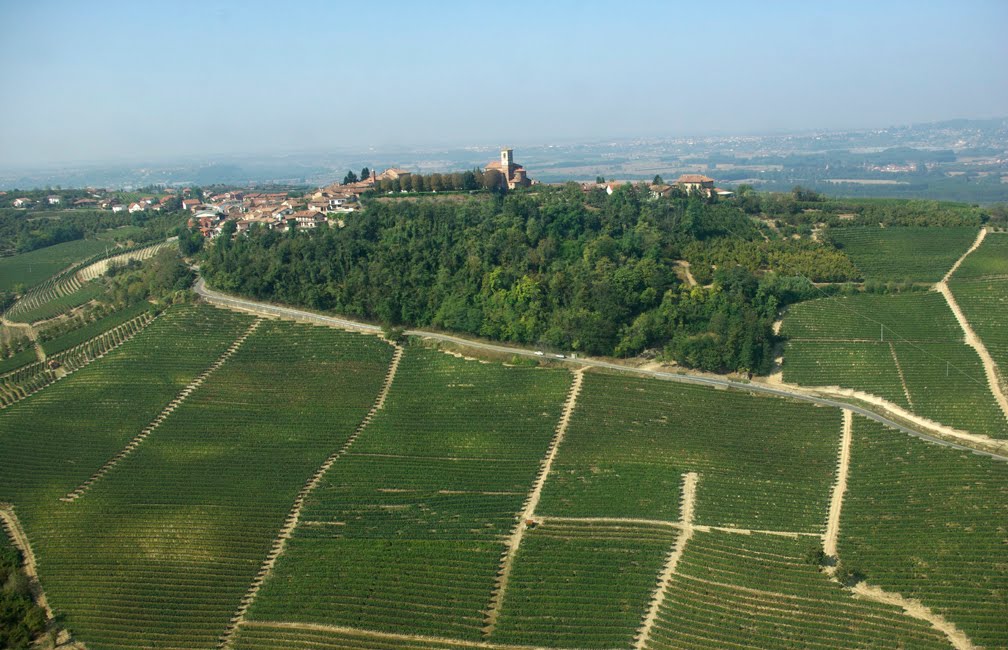
Vineyards at Verduno in the heart of the Barolo zone
Photo ©Tom Hyland


If this wasn’t bad enough, he also wrote a short piece on the 1999 Barolos and Barbarescos in this same issue. He writes that the 1999s were "never destined for greatness.” That did it for me! 1999 is an outstanding vintage as these wines offer excellent concentration as well as beautifully defined acidity, a combination winemakers – and wine drinkers – seek.

So why does Suckling believe that the 1999s are not great? According to his thinking, this wines are “lean.” Lean? The 1999s? He writes that they are not as concentrated as those from 1989, 1990, 1996 or 1997. He is arguably correct here, but does the fact that a vintage offers less depth of fruit that another mean it is not as good? What makes a Barolo or any wine great (and let me say here that the word great is overused by too many wine writers) is a combination of fruit, acidity, tannin and above all, balance. Bigger does not necessarily mean better. I have no problem with Suckling prefering the 1989, 1990 or 1996 vintage over 1999 (though I believe 1999 is far superior to 1997, as do many winemakers in Barolo), but to say that the 1999s from Barolo and Barbaresco aren’t great because they are not as intense as other vintages is futher proof of his misunderstanding of balance and structure as key roles in these wines. Callling the 1999s “lean” is like saying a 50-year old man who is 5’10” and weighs 175 pounds is lean. Compared to what, another 50-year old man of the same height who is 250 pounds? Maybe that man is overweight!

I’ve said it before and I’ll say it again – if you look to James Suckling for advice on Italian wines, you get what you deserve.

Monday, November 9, 2009

Gambero Rosso's quirks


The 2010 guide from Gambero Rosso has been out for a few weeks now and I wanted to discuss their latest look at the top Italian wines of the year. While this admittedly is a far more important publication in Italy, there are many wine buyers and Italian wine fans in this country that look to this guide as a barometer of the finest bottlings from Italy.

I am not writing this to take them to fault with any one particular wine; that is an exercise in futility. If you like a wine and I don’t, it’s not a matter of one of us being wrong or right. Rather we can agree to disagree on a wine. It’s the same with Gambero Rosso, especially as they prefer riper, oakier wines more often than I do. But that’s the nature of the beast – you take them at face value. I may not like a particular Brunello, Barolo or Amarone that GR favors due to its style (and style is a large part of why any of us like a wine, whether we admit it or not), but at least if Gambero Rosso gives a wine its top award of Tre Bicchieri (three glasses), I want to know the wine is worthy of that honor.

Thus I have a problem with the 2010 guide awarding their highest rating to 33 examples of Barolo from the 2005 vintage. Barolo is certainly one of the two or three most exemplary red wines of Italy, but that doesn’t mean it’s great in every vintage and 2005 is proof of that. I tasted more than 150 examples this past May at the Alba Wines Exhibition, a first-rate event for journalists from around the world that I attend every year. Of the 150, I found four (that’s F-O-U-R) wines that I thought were of the highest quality.

Now granted, there are some famous bottlings I did not try then, so perhaps there are a few more examples I might have rated as outstanding. But it’s hard for me to believe that there are 30 Barolos from 2005 that are exceptional, as Gambero Rosso would have us believe. As I said previously, I want to know a wine is worthy of that honor and I don’t believe 2005 was the type of vintage that yielded greatness.

Perhaps Gambero Rosso has a quota for awarding a certain number of Barolos with Tre Bicchieri. How elese do you explain that last year (in the 2009 guide) they awarded 31 bottlings of 2004 Barolo with this award? Add in three additional 2004 Barolos given the award this year (these three wines were released later than most examples from 2004) and you have basically the same number of 2004 Barolos getting the top award as those from 2005. This is quite remarkable and in reality, quite a strange ranking of Barolo. I do like the 2005 Barolos very much (see my tasting notes on several dozen of these wines at the vinowire blog), but the vintage doesn’t come close to 2004. That was an outstanding vintage, as the wines were more deeply concentrated, with more pronounced aromatics and greater complexity. Quite simply, it’s a bit ridiculous to award as many Barolos from 2005 as highly as their counterparts from 2004. How else can you explain this except to think there is an allocation each year in the guide for a certain number of Barolos?

Contrast that with Brunello di Montalcino. While wine writers argue about the merits of 2004 for Brunello (I think it was excellent, while others have written that the wines are a bit light for the vintage and not that great), no one questions that 2004 was a far superior year for Brunello as compared with 2003. Happily, Gambero Rosso agrees, as last year they awarded only one 2003 Brunello (Biondi-Santi) with their top rating, while 16 bottlings of 2004 Brunello earned that award. This is a little more like it, so why the discrepancy between Barolo and Brunello? (By the way, GR, yes on the Tre Bicchieri to the 2004 Brunellos from Talenti – a wonderfully underrated traditional producer – Poggio di Sotto and Poggio Antico “Altero”, but why not Il Poggione, Col d’Orcia or Pian dell’Orino?)


I do want to point out that there are some very good Tre Bicchieri awards this year, especially to some wines that don’t get anywhere near the attention given to Barolo or Brunello. The 2007 Etna Rosso “Musmeci” from Tenuta di Fessina was honored with the top award and it’s nice to see this recognition for this new company. I visited the vineyards this past March and tasted the new releases and was thoroughly impressed. The “Musmeci” is a lovely, supple Etna red made from 80 year old vines; the morel cherry and red floral aromas are gorgeous and the wine is quite velvety. This is NOT a wine that favors power over elegance, so nice work by GR in recognizing this wine with their top honor.

Also, nice of GR to recognize Villa Monteleone with the award for their 2005 Amarone. Monteleone is managed by Lucia Raimondi, who has been responsible for everyday operations since the death of her husband a few years back. Her wines are as gentle as she is – she is such a lovely person and how nice that all of her hard work has paid off. This is an Amarone of suppleness; it’s nice to see another producer depart from the ultra ripe, oaky approach taken with too many examples of Amarone these days. By the way, if you like the Villa Monteleone Amarone, I think you’d love their Ripasso bottling labeled “Campo San Vito”; I think it’s a better wine than the Amarone.

Finally, congratulations to the superb Soave producer Ca’Rugate for two Tre Bicchieri awards, one for their 2008 “Monte Fiorentine” bottling (a wonderfully rich no-oak Soave Classico that is simply delicious) and for their 2007 Recioto di Soave “La Perlara”. For several years, Ca’Rugate has been one of the very best producers of Recioto di Soave (only Pieropan can match their consistency with this product, in my opinion) and it’s about time that GR gave them this award. In fact, I believe this is the very first time GR has given a Recioto di Soave their top rating. If you haven’t tried a Recioto di Soave, you will love this lush, lightly sweet dessert wine with a delicate nuttiness – it’s quite rich and it ages for a long time. Congratulations to winemaker Michele Tessari and the rest of his family for their work with these two wines and their entire lineup. Ca’Rugate is a great Italian winery and how nice that Gambero Rosso has noticed that (for several years now, I must add) as well!

Tuesday, September 1, 2009

2005 Barolos - Many Promising Wines

Brunate, one of Barolo's finest crus and the source of outstanding and excellent Barolos from the 2005 vintage
(Photo ©Tom Hyland)


Enough about the mess in Montalcino, let’s turn our attention to a positive subject for Italian wines at the moment – the release of the new Barolos from the 2005 vintage.

You should realize that you will be subjected to a number of reviews in the coming months about the 2005 Barolos stating that these wines are not like the 2004s, which were outstanding. This is true, but unfortunate, as 2004 was a brilliant vintage for Barolo and brilliant just doesn’t come along every year – in fact, it doesn’t come along but once or twice a decade, if that much. So remember that, please.

So let’s be fair with the 2005 Barolos; this was a successful vintage and there are some excellent wines and even a handful of outstanding ones. The best offerings are medium-full with very good to excellent concentration, offer very good acidity and refined tannins. This is not a powerhouse vintage and the wines are not as complex in aromatics as the 2004s, but overall, these are very well made wines. The finest Barolos from 2005 will age for 15-20 years and while that is not as long as a great year such as 2004, 2001, 1999 or 1996, that is still impressive.

I tasted over 100 different Barolos from the 2005 vintage this past May in the city of Alba at the annual Alba Wines Exhibition. The wines were tasted blind, and as usual with this practice, I found many pleasant surprises along with a few disappointments. This is always an excellent tasting and my thanks to the hard-working staff of wellcom for their organization.

There were a few outstanding wines including the Bartolo Mascarello, Prunotto, the “Brunate” from Francesco Rinaldi and the “Gabutti” from Giovanni Sordo. The Prunotto was beautifully styled and is one of the best bottlings I’ve had from this producer in some time, while the Mascarello and Rinaldi are classic bottlings, made in a traditional style (aged only in large casks). These wines offer a lovely combination of spice, fruit and gentle tannins and are textbook representations of terroir. Barolo to me is all about terroir; the roundness and floral aromatics of the wines from La Morra standing next to the structure and firm tannins of the wines from Monforte or Serralunga, so I prize this distinctiveness far more than power or ripeness. As for the wine from Sordo, I’ve always liked the offerings from this small estate in Serralunga, but this cru bottling is as good as I’ve tasted; it’s a lovely wine with beautiful complexity.


Sergio Barale produced an excellent Barolo from the Cannubi vineyard in 2005
(Photo ©Tom Hyland)


Other excellent Barolos from 2005 include the Sergio Barale “Cannubi”; the “Brunate” from Oddero; Marcarini “Brunate”; Michele Chiarlo “Cerequio”; Fontanafredda “La Rosa"; the Massolino "Margheria"; the "Ravera" from Elvio Cogno; the Prapò bottling of Ceretto and the Famiglia Anselma bottling.

There are several more bottlings I’ve rated as excellent; you’ll be able to read about these wines in the upcoming Fall issue of my Guide to Italian Wines. This will include reviews not only reviews of the 2005 Barolos, but also the excellent 2006 Barbarescos (tasted in Alba the same week as the Barolos) as well a few dozen new releases of wines from Campania. To learn about subscribing to my Guide to Italian Wines, click here.